Sostenus Wilherm
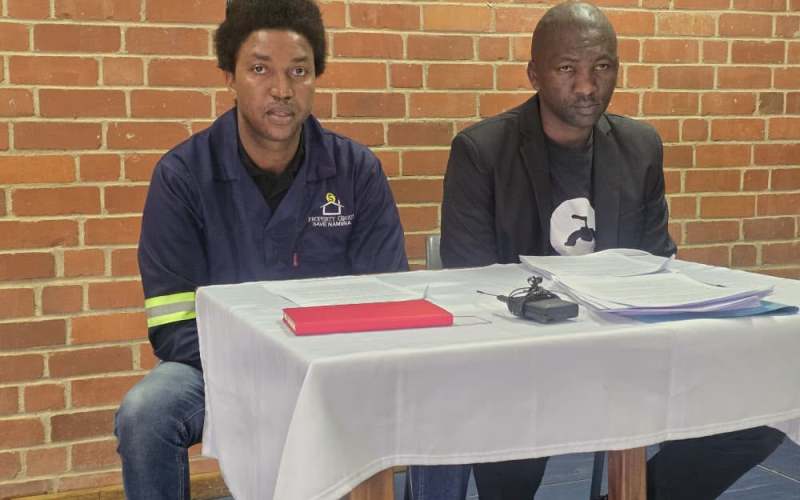
Social activists Shaun Gariseb and Michael Amushelelo have called on the City of Windhoek to account for its delivery of serviced land, municipal infrastructure and public services, warning that residents need measurable results rather than further plans and presentations.
In a joint statement on the alleged state of the City of Windhoek, the two said serviced land should be treated as an emergency municipal priority, arguing that access to land is closely linked to housing, sanitation, electricity, roads and security of tenure.
“Serviced land delivery must become an emergency municipal priority,” they said.
They cited a housing backlog of approximately 60 000 units, saying City of Windhoek officials have indicated that about N$1 billion would be required over four years to meaningfully address the backlog, including approximately N$900 million for land servicing.
Gariseb and Amushelelo said residents should be able to measure the municipality’s planned land delivery against actual results.
They referred to its strategic plan, which contemplated the servicing of approximately 700 greenfield erven annually, and called for information showing how many erven were planned, surveyed, proclaimed, connected to water and sewerage, electrified, provided with roads, allocated and ultimately transferred or secured for households.
“Do not give residents another presentation. Give them the numbers,” they said.
The two also raised questions about approximately 11 226 erven across 18 townships referred to in recent regional reporting, stressing that completed layouts should not be confused with serviced land.
“A layout on a drawing is not a serviced erf. An environmental application is not a serviced erf. A proclamation or Council resolution is not, by itself, a serviced erf,” they said.
They are demanding an implementation schedule showing how many of the 11 226 erven have physically been serviced, how many are expected to be serviced by December 2026 and how many will be delivered in 2027.
They also want disclosure of costs per erf, appointed contractors, procurement status and reasons for delays.
They further call for a settlement-by-settlement programme for the formalisation, upgrading, servicing and provision of security of tenure in informal settlements.
Beyond land, the two raised concerns about municipal finances, senior management costs, official travel, procurement, business Fitness Certificates, heavy-vehicle permit fees, informal trading, pensioners, Build Together beneficiaries, municipal workers, roads and refuse collection.
On official travel, they said questions had been raised about travel undertaken by the municipality’s chief executive officer Moses Matyayi.
They acknowledged that Matyayi had defended official travel as being linked to institutional learning, benchmarking, investment promotion and municipal partnerships.
“The answer to controversy is transparency,” they said, calling for a complete register of official domestic and international travel since his appointment, including destinations, dates, purposes, approvals and total municipal costs.
They also called for publication of measurable outcomes from international engagements, including any investment, partnerships, grants, technical assistance or savings resulting from such trips.
On municipal service delivery, the statement calls for ward-by-ward reporting on road maintenance, pothole repairs, water, sewerage, refuse and streetlights.
The activists also questioned delays in the processing of Fitness Certificates, noting that the council’s published service information indicates an expected processing period of approximately 10 working days.
They want the municipality to disclose the number of outstanding applications, applications exceeding 10 working days, the average processing time and the administrative bottlenecks causing delays.
Gariseb and Amushelelo said they intend to gather at the City of Windhoek offices on 26 September 2026 at 09h30, where they expect the mayor, council leadership and relevant heads of departments to receive residents and ratepayers.
“Our central message is simple: service the land,” they said, while also calling for transparency in public spending and improved municipal services.
They added that the local authority’s performance should ultimately be measured by tangible outcomes, including serviced land, improved tenure security, repaired roads and access to water, electricity and sanitation.
“We are not asking the city to perform miracles. We are asking the city to perform its mandate,” they said.