Sostenus Wilherm
After 17 years of curriculum development, testing and review, the Namibian Police Force (Nampol) has secured accreditation for its basic police training programme.
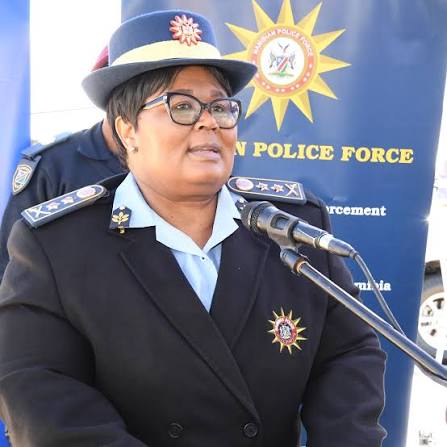
However, acting Inspector General Major General Anne-Marie Nainda said the achievement will have little meaning unless it translates into better policing and service delivery to the public.
Nainda made the remarks during the official receipt of accreditation certificates at the Namibia Qualifications Authority (NQA) headquarters in Windhoek, where the Nampol Certificate in Policing was formally recognised at National Qualifications Framework (NQF) Level 5.
She described the accreditation as more than an administrative milestone, saying it establishes a new professional standard for police recruits across the country.
“The qualification is strategically designed for the members recruited into the Namibian Police Force exclusively; therefore it marks a defining moment in the standardisation of policing in Namibia,” Nainda said.
The accredited Police Basic Course represents a significant expansion from the force’s previous training programme, which consisted of six core modules delivered over six months.
The new programme runs for 12 months and includes 11 core modules, with the force saying it is designed to equip recruits with competencies suited to the changing demands of modern policing.
Nainda said the journey towards accreditation was not achieved overnight, with curriculum development, institutional reflection, pilot testing and reviews taking place over 17 years.
The formal accreditation drive was launched on 21 July 2022, followed by the submission of Nampol’s application to the NQA on 27 October 2023.
The application underwent institutional audits, documentary verification, curriculum scrutiny, compliance assessments and technical engagement before accreditation was awarded on 11 June 2025, covering the period until June 2028, subject to reapplication in 2027.
“The three-year accreditation period should not be viewed as a comfortable finish line. It should be treated as a period of active and constant institutional improvement,” she said.
She said Nampol must continue strengthening its quality-assurance systems, reviewing training content and ensuring that police training keeps pace with evolving crimes and changes in the law.
The revised curriculum also incorporates technology and legal developments, including advanced information and communication technology modules and updated legal frameworks.
Nainda said traditional policing values such as discipline, resilience and physical fitness would remain central, but would now be strengthened by evidence-based practices, technology and professional accountability.
The accreditation will apply across Nampol’s four training institutions: the Israel Patrick Iyambo Police College in Khomas, Ruben Danger Ashipala Police Training Centre in Oshana, Pius Joseph Kaundu Police Training Centre in Omaheke and Simon Mutumba Mutumba Police Training Centre in Zambezi.
Nainda said this would ensure that recruits receive training against common national standards regardless of where they are trained.
“Whether recruits are trained in Windhoek, Ondangwa, Gobabis, or Katima Mulilo, they will all be trained against common national standards,” she said.
“This means that the quality of police training does not depend on the geographical training environment.”
The force intends to pursue accreditation for additional strategic programmes, including instructional skills, traffic law enforcement and criminal investigation courses.
Nainda also linked the professionalisation of police training to public trust, saying the ultimate test of the accreditation would not be the certificate itself but how officers conduct themselves when interacting with members of the public.
“The public will ultimately judge this accreditation not only by the official seal on a certificate, but by the conduct of officers in their neighbourhoods; at police stations, on road patrols, during investigations, and across every routine encounter where a citizen seeks safety and justice,” she said.
She urged police officers to maintain professional conduct and uphold high standards in their dealings with the public.
“A professionally trained officer is not merely an agent of force, but a bearer of the policing torch and a guardian of the Constitution,” Nainda said.
She said the real work begins after the accreditation, urging Nampol to translate the recognition into quality training, improved policing and efficient service delivery.
“The foundation is laid. The standards are verified. The certificates are in our hands. Let us now translate this achievement into quality training, improved policing, and efficient service delivery to the Namibian people,” she said.