Sostenus Wilherm
The ministry of justice and labour relations has moved to stop construction companies from paying security workers as little as N$12.82 an hour, warning that a recently gazetted wage provision falls below Namibia’s legal minimum of N$16 an hour.
The ministry issued the clarification after a collective agreement between the Construction Industries Federation of Namibia (CIF) and the Metal and Allied Namibian Workers Union (MANWU) prescribed security-guard rates of N$153.88 for a 12-hour shift in its first year and N$161.57 in the second year.
Those rates translate to approximately N$12.82 and N$13.46 an hour, respectively, putting them below the statutory minimum wage for security workers.
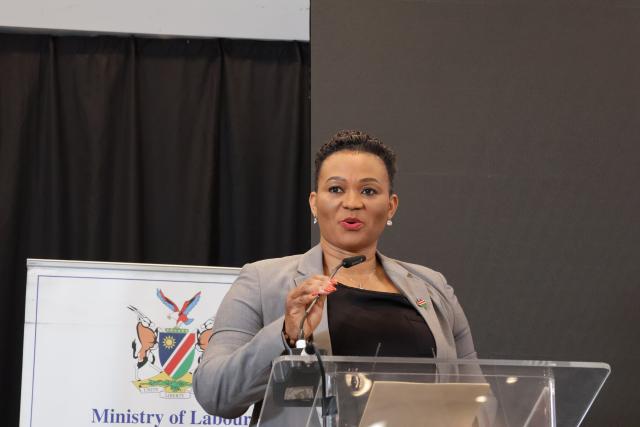
Acting executive director Aune Mudjanima said the lower rates cannot override the National Minimum Wage, which provides greater protection to workers.
“The National Minimum Wage should take precedence wherever the agreement prescribes a less favourable wage such as in this case,” Mudjanima said.
The ministry said security workers in the construction industry must currently receive at least N$16 per ordinary hour during 2026, with the rate increasing to N$18 per hour from 1 January 2027.
The clarification follows the publication of Government Notice No. 271 in Government Gazette No. 9010 on 1 September 2026, which extended the CIF-MANWU collective agreement to the construction industry.
The ministry said the National Minimum Wage Order, published under Government Notice No. 218 of 2024 and amended by Government Notice No. 6 of 2025, requires every employer to pay no less than the prescribed statutory minimum.
“A contract of employment or collective agreement applies only where it provides a more favourable condition of employment,” Mudjanima said.
This means construction employers cannot rely on the lower security-guard rate contained in the collective agreement to justify paying workers below the statutory minimum.
The ministry, however, clarified that the disputed wage provision does not invalidate the rest of the collective agreement.
“The remaining provisions of the collective agreement continue to apply, including any terms that are more favourable to employees,” Mudjanima said.
The difference in the two rates could have a direct impact on workers’ earnings.
At the current statutory minimum of N$16 an hour, a security worker working a 12-hour shift should receive N$192, compared with the N$153.88 provided for under the disputed collective agreement provision.
From January 2027, the N$18 minimum will amount to N$216 for a 12-hour shift.
The ministry said the discrepancy is being addressed and that the relevant provision will be corrected through the appropriate process.
Mudjanima said employers and employees should continue applying the higher statutory rate until the correction is formally made.
“Until the correction is formally effected, the higher National Minimum Wage remains applicable and must be observed,” she said.
The ministry’s intervention effectively puts construction employers on notice that the lower rate cannot be used as a basis for determining security workers’ pay.
The dispute also highlights the limits of collective bargaining where negotiated provisions conflict with statutory minimum protections.
While collective agreements remain an important mechanism for determining wages and working conditions, they cannot provide workers with conditions that are less favourable than those guaranteed by law.
The ministry said it recognises the CIF-MANWU agreement as an important outcome of collective bargaining and remains committed to social dialogue between employers and workers.