Patience Makwele
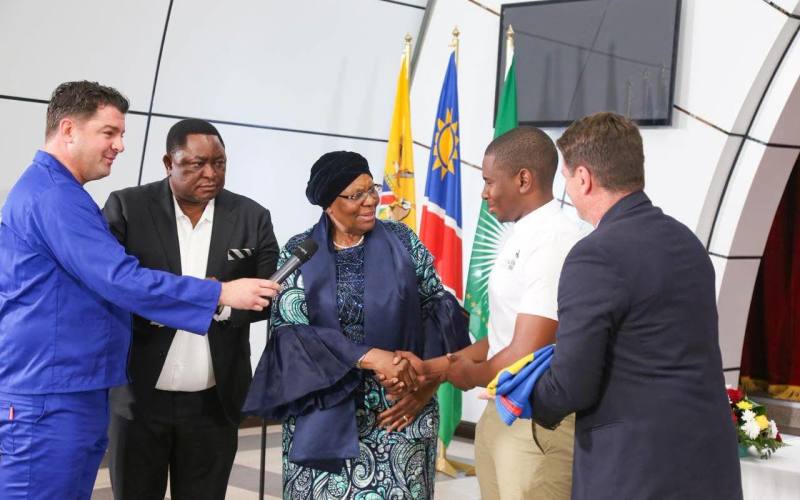
President Netumbo Nandi-Ndaitwah has called for a closer match between the skills Namibians acquire and the demands of the labour market, saying the country cannot continue to grapple with unemployment while employers face skills shortages.
“We cannot continue to talk about unemployed Namibians when there is a gap in the labour market,” Nandi-Ndaitwah said on Monday during the official send-off of Team Namibia to the 48th WorldSkills Competition scheduled to take place in Shanghai, China.
She said young Namibians must understand where opportunities are emerging and look beyond traditional career paths.
“When I was growing up, the idea was that you become a teacher, you become a nurse or you become a pastor. But now, everything is open to us,” she said.
Nandi-Ndaitwah said skills development would become increasingly important as Namibia expands opportunities in green hydrogen, oil and gas, renewable energy, advanced manufacturing and digital technology.

She called for regular skills audits and labour-market analyses to ensure training institutions respond to what the economy needs.
“We must add value to our natural resources in order to eliminate poverty in our country,” she said, stressing that economic transformation must be accompanied by social transformation.
Nandi-Ndaitwah also urged Team Namibia to return from Shanghai with knowledge that can benefit other young people, proposing that the competitors establish a platform or workshops where they can share what they learn internationally.
The team comprises 17 competitors of 13 males and four females who will be competing in 16 skills. The competitors were selected through the national skills competition and come from public vocational training centres, secondary schools, private training institutions and industry.
WorldSkills Namibia manager and technical delegate Sens Shoolongo said the competitors were selected against international WorldSkills standards through a national competitive process.
He said the delegation’s composition also reflects growing participation by women in traditionally male-dominated skills.
“This is an indication that women are now entering fields that were traditionally dominated by men,” Shoolongo said.
He said the team would compete against more than 1,600 competitors from countries and regions around the world, while the delegation also includes a team doctor for the first time.
Namibia has been a WorldSkills member since 2011 and began participating physically in the international competition in 2015.
Namibia Training Authority(NTA) chief executive officer Erick Fundula Nenghwanya said the competition demonstrates the role of technical and vocational education and training (TVET) in preparing young people for economic participation.
He said TVET should not be viewed merely as an alternative education pathway, but as part of the country’s broader economic development agenda.
Also speaking at the send-off, competitor Beverly Oases, who will represent Namibia in Restaurant Service, shared that the journey to Shanghai has involved long training days, early mornings, mistakes and constant correction.
She said the experience had taught the competitors that excellence requires discipline, patience and resilience.
“Do not be afraid to choose a technical or vocational area. Do not underestimate what people can achieve through skills,” Oases said.
She said the competitors may come from different regions and institutions but would represent Namibia as one team in Shanghai.
“We may come from different regions, institutions and different skills, but in Shanghai we will be one Team Namibia,” she said.
The competitors are scheduled to compete from September 22 to 27, with Oases saying they are carrying with them the aspirations of young Namibians who want to become artisans, technicians, engineers, entrepreneurs and innovators.
Nandi-Ndaitwah urged the team to use the international exposure to bring back knowledge that could benefit Namibia’s wider youth population.
She said TVET should no longer be regarded as a backup plan, but as a critical component of Namibia’s economic transformation.