Renthia Kaimbi
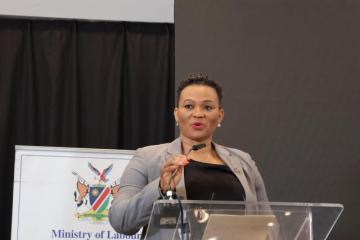
Erongo Governor Nathalia /Goagoses has warned investors against exploiting divisions within indigenous communities in the region to advance personal or business interests, saying communities must have a meaningful say in the exploitation and beneficiation of the natural resources found in their areas.
Delivering the closing remarks at the European Union’s Around the Table: A Green Industrialisation Dialogue Series in Swakopmund on Thursday, /Goagoses said investors must move beyond consultations and token donations and instead structure benefit-sharing initiatives around the actual needs of host communities.
She said investments in water-stressed areas such as the Dâures constituency could, for example, include the construction of desalination plants, while other projects could support the construction of schools and houses for local residents.
“I don’t want talks and beautiful proposals. Don’t give our people a N$3 000 donation and come and praise yourself. We know what we have (natural resources), but we also know what we want,” she said.
The governor said communities should take ownership of the resources with which their areas are endowed and benefit directly from economic activities taking place on their land.
She questioned the value of repeatedly convening expensive conferences when the resources used to organise them could instead be channelled into addressing pressing challenges facing communities.
“Should I wait for a conference again next year, where you’ll spend millions to organise the event when I could have built so many houses for our people using that money?” she asked.
She emphasised that Namibia’s natural-resource beneficiation agenda should primarily benefit Namibians rather than a select few who, she said, pursue financial gain at the expense of broader development in resource-rich communities.
/Goagoses also called for community leaders to be included in consultations concerning the extraction of natural resources, particularly because many of these activities take place on communal land.
“I will not allow any consultations to take place without the custodians of communal land,” she stated.
She applauded the EU for initiating the dialogue, but stressed that benefit-sharing must translate into tangible and lasting improvements for communities.
“Let us not be too apologetic and be driven by money. Money is fine, but the true wealth and richness is here in Namibia. We are so rich in this country. God has blessed us with this endowment of natural resources,” she said.
/Goagoses further revealed that her office is preparing a submission advocating for the decentralisation of functions currently administered by the Ministry of Environment, Forestry and Tourism to regional councils.
She said governors needed greater authority to intervene in challenges affecting conservancies and communities, arguing that decisions and oversight could not effectively be managed from Windhoek.
“Some of these functions need to be decentralised so that governors can have the teeth to deal with some of these issues happening in these conservancies. They cannot sit in Windhoek and expect things to be monitored here. But by who?” she said.
According to /Goagoses, fragmented legislation also needs to be streamlined to strengthen oversight of activities taking place in conservancies, where governors currently have limited authority.
Community activist and Tsiseb Conservancy chairperson Jimmy Areseb called for mechanisms that allow different economic activities within conservancies to coexist, arguing that one activity should complement rather than undermine another.
“One must consolidate the other,” Areseb said.
He said whether activities involve consumptive or non-consumptive use of natural resources, the ultimate objective should be ensuring that conservancy members benefit from the resources in their areas.
Areseb cited the Dâures Green Hydrogen Village as an example of the challenges that can arise when major developments overlap with environmentally sensitive areas. He said the project was developed along a wildlife migration and movement route and in a sensitive breeding zone within the conservancy.
However, he said stronger coordination and environmental protection measures could allow such developments and conservation activities to coexist.
“In fact, if blasting (on mines) takes place, we need to be on the ground to observe what the reactions and movements of the animals are. And that’s one approach that we can take collectively,” he said.
Areseb also acknowledged the potential conflict arising from his dual roles as Tsiseb Conservancy chairperson and chairperson of the Brandberg Small Miners Cooperative.
He called on large mining companies to take existing economic activities within conservancies into account, particularly those involving small-scale miners.
“What is the approach of assuring that these small miners continue their extraction or are being assisted with further machinery and skills development to continue their activities in a protected area?” he asked.
He further raised concerns about the preservation of ancestral gravesites, saying these are often overlooked when large portions of communal land are allocated for development.
Areseb also urged the EU to consider regulating the Corporate Social Responsibility frameworks attached to projects it finances in Namibia.
He proposed that financing agreements contain mandatory clauses setting minimum funding thresholds for community development to ensure that benefit-sharing is not left to the discretion of investors.
The dialogue, titled Community Benefit-Sharing in Green Industrialisation: Learning from Namibia’s Experience to Shape the Green Industrial Transition, brought together government, industry, civil society, traditional authorities, communities, academia and development partners.
The half-day dialogue was held at the Strand Hotel in Swakopmund on 10 September and formed part of the EU’s Around the Table: A Green Industrialisation Dialogue Series.