CHAMWE KAIRA
Namibia’s removal from the Financial Action Task Force (FATF) grey list should strengthen confidence in the country’s financial system while serving as proof of what coordinated national efforts can achieve, finance minister Ericah Shafudah said following the country’s successful exit from the list of jurisdictions under increased monitoring.
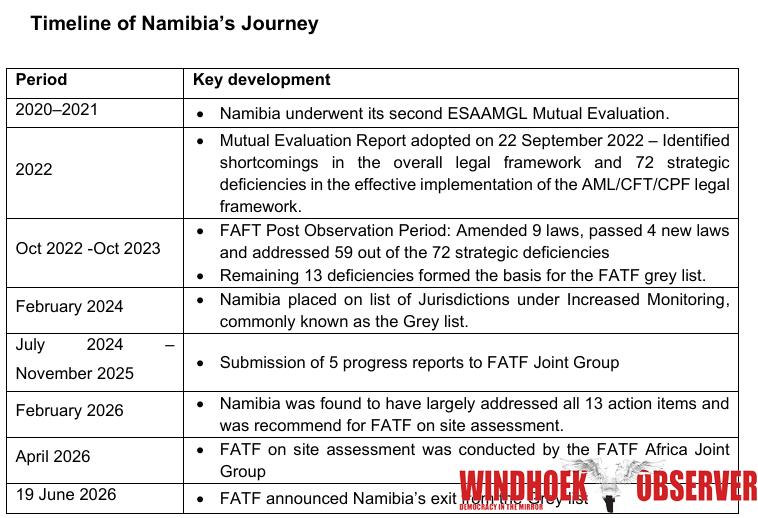
Shafudah welcomed the development, which became effective on 19 June 2026, but cautioned that the achievement should not lead to complacency.
“Namibia’s exit from the grey list should give us confidence, but not complacency. Let it serve as an example of what we can achieve when our institutions work together in pursuit of a national purpose,” she said.
The minister described the country’s removal from the grey list as an important national milestone reflecting political commitment, strong institutional coordination and sustained implementation of reforms to protect the integrity of Namibia’s financial system and align it with international standards.
Namibia was placed under enhanced monitoring after its second Mutual Evaluation, conducted between 2020 and 2022, identified strategic deficiencies in the country’s anti-money laundering, combating the financing of terrorism and proliferation (AML/CFT/CPF) framework.
The evaluation report was adopted by the Eastern and Southern Africa Anti-Money Laundering Group (ESAAMLG) Council of Ministers in September 2022.
In response, Cabinet endorsed a National Action Plan as a matter of national importance, signalling government commitment to strengthening the country’s financial crime prevention framework.
During the subsequent 12-month observation period, Namibia amended nine laws, enacted four new laws and addressed numerous strategic deficiencies identified during the evaluation.
The reforms were coordinated through the National Focal Committee, led by the Financial Intelligence Centre (FIC), which mobilised government institutions, strengthened governance structures and monitored progress while reporting to both Cabinet and the FATF.
Shafudah said the reforms were intended not only to secure Namibia’s removal from the grey list but also to establish a financial system that is stable, resilient and trusted, thereby supporting national security, economic stability, investor confidence and the country’s sovereignty.
She said tackling illicit financial flows remains central to Namibia’s development agenda, noting that such activities deprive the country of resources needed for infrastructure development, public services, job creation and economic transformation.
Under the Sixth National Development Plan (NDP6), Namibia aims to reduce illicit financial flows from 9% of gross domestic product in 2024 to 5% by 2030.
The minister stressed that maintaining the country’s improved standing will require continued implementating of the reforms, sustained institutional cooperation and ongoing investment in systems and controls ahead of the next mutual evaluation scheduled for 2030.
Bank of Namibia Governor and chairperson of the Anti-Money Laundering and Combating the Financing of Terrorism (AML/CFT) Council, Ebson Uanguta said Namibia’s removal from the Financial Action Task Force (FATF) grey list marks the successful conclusion of one of the country’s most significant financial governance reform efforts, while stressing that maintaining international standards will require continued vigilance.
“When Namibia was grey listed, the country faced a clear challenge. We had to demonstrate not only that our laws and policies met international standards, but that they were being effectively implemented,” he said.