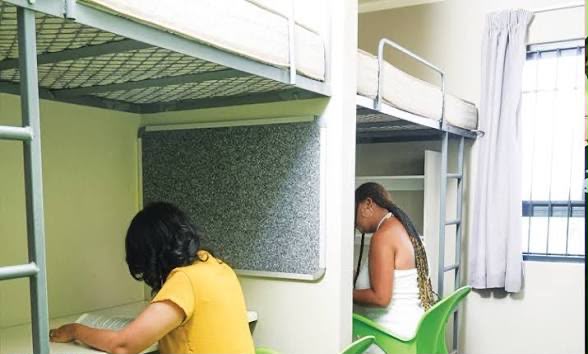
Accommodation barriers shape young people’s career choices
Patience Makwele
Limited student accommodation and a lack of courses outside major towns are forcing some young Namibians to abandon their preferred career paths and enrol for qualifications available closer to home, a student has told the Windhoek Observer.
Ndeapo Klaudia Paulus, who spoke to the Windhoek Observer after the launch of the sixth edition of the Careers in Namibia 2025-2026 Guide, said financial constraints, limited family support and difficulties securing accommodation at institutions in Windhoek often leave students from other regions with few options when choosing what to study.
Paulus said career choices are not always driven by peer pressure or parental expectations, but are often influenced by the circumstances students come from.
“Sometimes it’s not our parents or our friends as such that push us into pursuing careers and courses. Sometimes it’s because of the environment where we are found,” she said.
She said students who move to Windhoek to study at institutions such as the Namibia University of Science and Technology (NUST) and the University of Namibia (Unam) often struggle to secure accommodation, particularly those without relatives or other support networks in the capital.
The accommodation shortage is also reflected in Unam’s 2026 figures, which show that 2,389 students applied for accommodation at its Windhoek main campus, where only 1,150 beds were available.
The situation is especially difficult for students from families with limited financial support, including those who are the first in their families to pursue university education.
“Sometimes you are the first person to make it out of the family, as the person that is going to reach graduation,” she said.
Paulus said the limited range of courses available at institutions outside Windhoek also influences what students eventually study.
She gave the example of students from the Zambezi and Kavango regions who may want to pursue specialised fields such as computer engineering but cannot afford to relocate or have relatives in Windhoek to accommodate them.
Some consequently enrol for courses available closer to home, including teaching and office administration, even when those are not their preferred choices.
She referred to the University of Namibia’s Katima Mulilo campus when explaining the choices facing students from the region.
She called on the government to introduce more courses at institutions outside Windhoek and reconsider accommodation arrangements to make it easier for students from disadvantaged backgrounds to access higher education.
“We really want to pursue courses that are new and in demand and courses that can give us a job immediately after graduation. But then we look at what cost do I have to do this?” she said.
Her concerns come as deputy executive director in the ministry of justice and labour relations, Aune Mundjanima, warned that inadequate career guidance was contributing to young people making education choices without fully understanding the professions and opportunities available to them.
Mundjanima said some students enrolled for courses simply because institutions had available spaces, rather than because the qualifications matched their interests or career ambitions.
She also raised concerns about young people choosing qualifications because their friends were pursuing the same courses.
“Many young people lack access to comprehensive information about available career opportunities, sometimes the new emerging markets or economy that they can be able to penetrate and create their niche in,” she said.
Mundjanima said young people also needed information about the qualifications required in emerging industries to avoid saturating particular fields.
Namibia’s economy is evolving, with opportunities emerging in green hydrogen, renewable energy, oil and gas, mining, agriculture, tourism, logistics, manufacturing and information and communication technology.
She called on educational institutions to regularly review their curricula to ensure that the qualifications and skills they offer respond to changing industry requirements.
“So we therefore need to strengthen the connection between our education and training system and the actual need of the industry,” she said.
She added that young people should develop practical competencies alongside academic qualifications, including critical thinking, creativity, communication, problem-solving, digital literacy and entrepreneurial skills.
The Careers in Namibia 2025-2026 Guide provides information on career planning, professions, entry requirements, skills in demand, particularly in the green energy sector, and preparation for the world of work.
Paulus said the government should look beyond warning learners against pursuing popular courses and address the circumstances that limit their access to other career paths.
“It’s not that we are being peer pressured into doing engineering because my friend is doing engineering or doing teaching because someone is doing teaching. Sometimes it’s where we are coming from.”