There are moments in the life of a democracy when the conduct of politicians tells us more about the state of the institution than the outcome of the vote itself.
The National Assembly’s decision to approve Dr Gerson Sindano as the new chairperson of the Electoral Commission of Namibia (ECN) is one such moment.
The issue is no longer simply whether Sindano is qualified to chair the ECN. Nor should this newspaper presume that his appointment makes him incapable of acting independently. Those are questions that must ultimately be answered by his conduct in office. The more immediate concern is what the parliamentary process has done to public confidence in the institution.
And on that score, Parliament has failed badly.Namibia’s Parliament increasingly looks dysfunctional.
It is supposed to be the country’s foremost political forum: the place where disagreements are confronted, arguments tested, evidence examined and compromises negotiated. Instead, we have witnessed yet another episode of political theatre.
Opposition MPs walked out. The governing party proceeded with the vote. Forty-nine members voted in favour. Technically, the numbers may have settled the matter. Politically, they have not.
That distinction appears to be lost on both sides of the political divide. The opposition parties frequently portray themselves as the country’s political thinkers, the people asking the difficult questions, defending democracy and holding the governing party accountable.
But there is remarkably little evidence of sophisticated opposition politics in what happened.
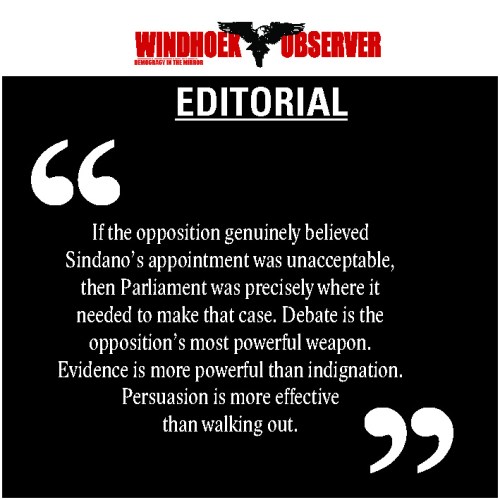
If the opposition genuinely believed Sindano’s appointment was unacceptable, then Parliament was precisely where it needed to make that case. Debate is the opposition’s most powerful weapon. Evidence is more powerful than indignation. Persuasion is more effective than walking out. A compelling argument placed on the parliamentary record can outlive a parliamentary protest.
Walking away may demonstrate anger. It does not necessarily demonstrate political intelligence. Opposition parties cannot simultaneously demand that Parliament be respected as the institution of democratic accountability and then abandon the chamber whenever the political arithmetic turns against them.
There are occasions when a walkout is justified. But when it becomes the principal response to losing an argument or failing to secure one’s desired outcome, it risks becoming political theatre rather than meaningful parliamentary resistance. The opposition needs to do better.
But SWAPO, as the governing party, carries the greater responsibility. And its conduct increasingly suggests an unfortunate philosophy: if we have the numbers, we can do it.
That is the politics of ruling by numbers. Of course, parliamentary majorities matter. That is the essence of representative democracy. A governing party cannot be expected to surrender its mandate simply because the opposition disagrees with it. But democracy is more than arithmetic.
Some institutions are too important to be treated as ordinary extensions of the majority’s political power. The ECN is one of them. The electoral commission is the referee of Namibia’s democratic contest. It administers the process through which political parties acquire the very parliamentary numbers they subsequently use to govern.
That creates an obvious principle: the institution responsible for determining who gets power must enjoy confidence across the political spectrum.
The appointment of its chairperson should therefore inspire confidence, not deepen suspicion. SWAPO may well argue that Sindano’s appointment is entirely legitimate and procedurally sound. It may even ultimately prevail in court, if the matter reaches the judiciary. But legitimacy has two dimensions.
There is legal legitimacy, and there is public legitimacy. A decision can satisfy the letter of the law while still leaving a substantial section of society questioning whether the process was sufficiently transparent, consultative and independent.
That is why this controversy matters. And there is one group that has received remarkably little consideration throughout this political confrontation:the voters.
They are the biggest losers. Namibians do not vote for political parties merely to give politicians the satisfaction of winning parliamentary battles. They vote because they expect the democratic system to work.
They expect elections to be administered fairly. They expect the referee to be trusted.
They expect Parliament to behave with seriousness. They expect politicians to understand that democratic institutions belong to the country, not to whichever party happens to have a majority at a particular moment.
Instead, voters are now left watching a dispute in which the opposition questions the appointment, the governing party pushes it through using its majority, and the legitimacy of the process becomes the subject of yet another political confrontation.
It is hardly surprising that the matter appears destined for court.
If the legal questions surrounding the appointment are substantial, then the courts should settle them. There is nothing inherently undemocratic about judicial scrutiny of parliamentary or executive action. Indeed, constitutional democracy depends upon precisely that system of checks and balances.
But it should concern everyone that an appointment to the leadership of the country’s electoral machinery has reached this point.
The ECN should not begin the tenure of its new chairperson already carrying the baggage of a political legitimacy dispute.
And Parliament should not be surprised if the public concludes that it failed to resolve the matter properly.
The governing party should therefore resist the temptation to celebrate the vote simply because it won.
The opposition should resist the temptation to celebrate the walkout simply because it made a political statement.
Neither side has won the bigger battle.
The bigger battle is public confidence in Namibia’s democracy.
The governing party needs to understand that having the numbers is not the same as having consensus.
The opposition needs to understand that having objections is not the same as having an effective strategy.
And Parliament needs to understand that democracy is not merely about counting votes after the debate. It is about the quality of the debate before the vote.
Dr Sindano now has the unenviable task of proving that he can lead the ECN independently and professionally despite the controversy surrounding his appointment.
He should be judged on his actions, not merely on his political history or the circumstances of his appointment.
But Parliament has made his job harder.
The ECN’s credibility will now depend not only on what its new chairperson does, but on whether Namibians believe he can do it independently.
That is a burden nobody should have imposed upon the country’s electoral referee.
Parliament had an opportunity to demonstrate that Namibia’s democracy is maturing. Instead, it demonstrated how far we still have to go.
And once again, it is the voter who is left paying the price.