There are certain things a government simply has to get right.
Education is one of them. Health is another.
Roads, airports, housing, economic development and a host of other national priorities matter enormously. But there is something fundamentally different about education and health: they are investments in the human beings who must ultimately carry the country forward.
That is why the recent videos circulating on social media showing the condition of some government-owned schools in Swakopmund should concern every Namibian.
The images are difficult to reconcile with the Namibia we would like to believe we are building.
Dilapidated buildings, deteriorating facilities and environments that appear wholly unsuitable for children to spend much of their formative years in should not become normalised simply because they are found in public schools.
And Swakopmund should not be viewed as an isolated case.

If anything, the images from an affluent and rapidly developing coastal town should force us to look beyond the town itself and ask a much larger question: what is happening in schools in the parts of Namibia that do not have the same visibility, political influence or economic resources?
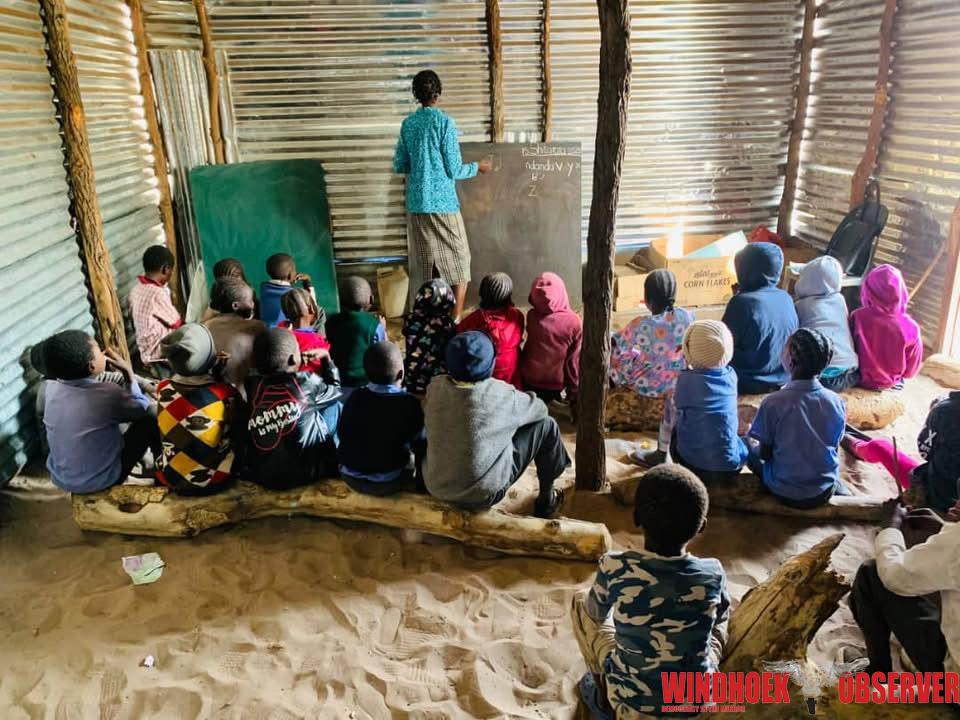
Because there are Namibian children who do not even have a classroom.
They are taught under trees.
That reality should embarrass us, not because teaching under a tree is inherently a failure of the teacher or community, but because, after more than three decades of independence, a child’s access to a basic classroom should not depend on whether he or she happens to be born in Windhoek, Swakopmund, Walvis Bay or a remote rural settlement.
The contrast is particularly stark.
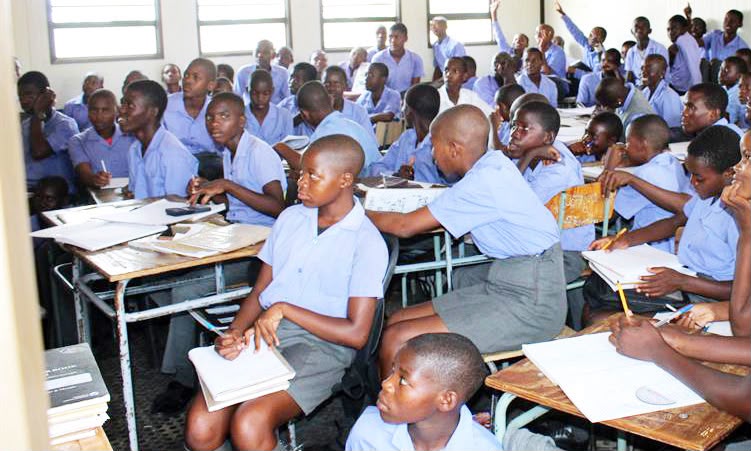
One child may sit in a modern classroom with electricity, internet connectivity, laboratories and adequate sanitation.
Another may sit under a tree, exposed to the elements, attempting to concentrate on a mathematics lesson while the teacher competes with wind, heat, rain and every other distraction that nature can provide.
They are both Namibian children.
They both have the same constitutional right to education. And they both represent Namibia’s future.
UNICEF Namibia notes that Namibia has achieved net enrolment of more than 90% among children aged seven to 18 and allocates more than 20% of the national budget to education.
Yet the organisation also points to continuing inequalities in access and a learning crisis in which children can be physically present at school without acquiring basic reading and mathematical skills.
That distinction is important. Getting children into schools is only one part of the job. We must also ensure that the schools are places in which children can actually learn.
A roof is not a luxury. A functioning toilet is not a luxury. Clean water is not a luxury. Electricity is not a luxury. A desk, a chair, adequate ventilation and a safe classroom are not luxuries.
They are the minimum physical conditions under which a modern education system should operate.
And this is where the conversation about Namibia’s education infrastructure becomes uncomfortable.
We cannot continue to measure educational success primarily by how much money is allocated to education or how many children are enrolled.
The more important question is what happens to that investment when it reaches the classroom.
A significant amount of education spending inevitably goes towards salaries and recurrent expenditure. That is understandable. Teachers are the backbone of the education system and must be paid properly.
But infrastructure cannot be an afterthought.
A teacher cannot compensate indefinitely for a broken classroom.
A dedicated principal cannot manufacture a science laboratory.
A committed parent cannot build a school from goodwill alone.
And a child cannot be expected to compete academically with children from better-resourced environments simply because we have told them that education is the great equaliser.
Education only becomes an equaliser when the system provides a reasonably equal platform from which children can learn.
UNICEF’s earlier analysis of Namibia’s education infrastructure identified a substantial classroom deficit and warned that inadequate infrastructure was contributing to deprivation and inequality.
It also highlighted shortages in water, sanitation and information and communications technology.
The fact that some of these challenges have persisted should concern us.
Namibia has never been a country without resources.
The issue is therefore not simply whether resources exist. It is also about how we prioritise, plan, budget, procure, construct, maintain and monitor public infrastructure.
There is another problem that deserves attention:maintenance. Building a school is only the beginning.
Public infrastructure deteriorates. Roofs leak. Windows break. Toilets fail. Electrical systems need maintenance. Walls need painting. Furniture gets damaged. Water systems require repairs.
If there is no systematic maintenance programme, today’s new school becomes tomorrow’s dilapidated school.
And that is where the government must move beyond the mentality of constructing projects and start thinking in terms of managing public assets.
Every school should effectively have a lifecycle.
There should be a clear understanding of when a roof will require maintenance, when sanitation systems need upgrading, when electrical infrastructure needs inspection and when classrooms require refurbishment.
There is another problem that deserves attention:maintenance. Building a school is only the beginning.
Public infrastructure deteriorates. Roofs leak. Windows break. Toilets fail. Electrical systems need maintenance. Walls need painting. Furniture gets damaged. Water systems require repairs.
If there is no systematic maintenance programme, today’s new school becomes tomorrow’s dilapidated school.
And that is where the government must move beyond the mentality of constructing projects and start thinking in terms
This is not revolutionary thinking. It is basic asset management.
The private sector does it because buildings and equipment represent capital that must be protected.
The government should do the same because public infrastructure belongs to the people.
The problem becomes even more serious when we consider rural Namibia.
The children in remote communities already face disadvantages that children in urban centres may not.
They may live far from schools. They may have limited access to electricity and internet connectivity. They may face shortages of teaching materials and qualified teachers.
Their parents may have fewer economic resources to supplement what the state provides.
UNICEF continues to identify poor infrastructure, inadequate learning materials and limited human resources as factors affecting learning outcomes in Namibia, with rural and poorer children particularly vulnerable to exclusion and dropout.
The digital divide adds another layer.
We increasingly talk about artificial intelligence, coding, robotics, digital literacy and the future of work.
But what does AI mean to a child who does not have reliable electricity?
What does digital transformation mean to a school without internet connectivity?
What does a technology-driven economy mean to a learner who is still struggling to access a functioning classroom?
There is a danger that Namibia could create two education systems without formally declaring that we have done so: one increasingly connected, technologically enabled and globally competitive; another struggling to provide the basic physical environment required for learning.
That would be a profound national failure.
It is therefore important to acknowledge something else.
The current administration did not create every problem in Namibia’s education infrastructure.
Many of these challenges are structural and accumulated over decades. Governments inherit schools, budgets, contracts, maintenance backlogs, demographic pressures and infrastructure deficits from their predecessors.
There are also competing demands on the national fiscus. Namibia must fund healthcare, social protection, housing, roads, water, electricity, security, agriculture and economic development.
The government cannot fix everything simultaneously.
But recognising that reality cannot become an excuse for doing too little. Governments are elected, in part, to make choices.
And education infrastructure should be among the choices that receive sustained attention. The answer is not necessarily to build thousands of expensive new schools.
In some communities, the immediate need may be additional classrooms. In others, it may be renovation. Elsewhere, it may be water, sanitation, electricity, teacher accommodation or internet connectivity.
The response must therefore be based on a national infrastructure audit that identifies precisely what each school needs, what it will cost and how urgently it must be addressed.
That information should not sit in a ministry filing cabinet. It should be public.
Namibians should be able to see how many schools require urgent rehabilitation, how many classrooms are needed, where the shortages are, what projects have been approved, what they cost, who is constructing them and when they are expected to be completed.
Transparency would also help address another longstanding problem: the gap between announcements and delivery.
Too often, public infrastructure becomes a political announcement rather than a measurable commitment.
A school is announced. A groundbreaking ceremony takes place. A minister speaks. Photographs are taken. And then the community waits. What matters is not the ceremony.
What matters is the child eventually sitting in the classroom. We should also reconsider the role of the private sector and communities.
The government has the primary responsibility for public education, but it does not have to carry every infrastructure burden alone.
Mining companies, banks, telecommunications companies, retailers and other major businesses already participate in corporate social investment.
Those programmes could be coordinated around national education infrastructure priorities rather than fragmented projects that look impressive individually but do little to address systemic shortages.
Communities, too, should be empowered to participate in monitoring school infrastructure.
But partnerships must supplement—not replace—government responsibility.
Education cannot become dependent on corporate goodwill.
A child’s right to a decent classroom should not depend on whether a mining company happens to operate nearby.
Ultimately, this is about more than buildings.
A school communicates something to a child.
A clean, safe, functioning school says: you matter.
A neglected school communicates something else.
It can inadvertently tell a child that the society around them does not expect very much from their future.
That is why the images from Swakopmund should not simply trigger another social-media outrage cycle.
They should trigger a national conversation.
We should look at Swakopmund, but we should also look at the rural north, the Kavango regions, Zambezi, Kunene, Omaheke, Otjozondjupa, //Kharas and every other part of the country where children are learning in conditions that would be unacceptable for adults working in government offices.
We should ask difficult questions about budgets, procurement, maintenance, planning and accountability.
But above all, we should ask ourselves what kind of Namibia we are building.
Because the quality of our schools is not merely an education issue. It is an economic issue. It is a social issue. It is a human-capital issue. It is a national-development issue.
The Namibia of 2040, 2050 and beyond is sitting in our classrooms today. Some are sitting at proper desks. Some are sitting in overcrowded classrooms.
Some may be struggling in deteriorating buildings.
And somewhere, another child may be sitting beneath a tree. We owe all of them more. Not tomorrow. Not when the fiscal situation improves.
Not when another development plan is written.
Now.
Because if we genuinely believe that Namibia’s greatest resource is its people, then the most important infrastructure we build must be the infrastructure that develops those people.
A nation cannot educate its children on promises. It needs classrooms. It needs laboratories. It needs libraries. It needs water and sanitation. It needs electricity and connectivity. It needs teachers. It needs maintenance.
And above all, it needs the political and administrative discipline to ensure that education infrastructure is treated not as another line item in a budget, but as one of the foundations upon which the entire country rests.
If the classroom is falling apart, we should not only ask who built it.
We should ask what it tells the child sitting inside it about the value we place on their future.
That is the question Namibia can no longer afford to ignore.