
Staff Writer
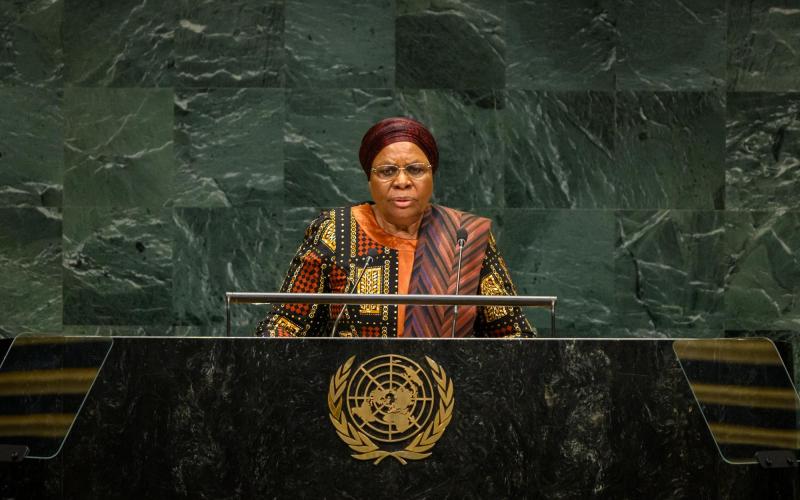
President Netumbo Nandi-Ndaitwah has called for a woman to be elected as Secretary-General of the United Nations for the first time in the organisation’s history, placing gender equality and women’s leadership at the centre of her address to the 81st UN General Assembly.
Speaking in New York last night under the theme “Restoring Trust, Managing Transformation”, Nandi-Ndaitwah said the international community should seize the opportunity to advance women’s representation at the highest level of global governance as it considers the succession to outgoing Secretary-General António Guterres.
She reaffirmed Namibia’s commitment to gender equality and the implementation of UN Security Council Resolution 1325 on Women, Peace and Security, while making a direct appeal for the world body to be led by a woman.
Her call came alongside an expression of solidarity with countries and peoples affected by conflict, including Sudan and the eastern Democratic Republic of Congo, where ongoing instability continues to pose serious humanitarian and security challenges.
Nandi-Ndaitwah said the continued conflicts demonstrated the need for a United Nations capable of responding more effectively to threats to international peace and security, while strengthening international cooperation and restoring confidence in multilateralism.
A central focus of her address was the reform of the UN Security Council, with Namibia reiterating its support for the Common African Position as articulated through the Ezulwini Consensus and the Sirte Declaration.
Nandi-Ndaitwah said Africa’s longstanding demand for greater representation in global decision-making must be recognised, pointing to the continent’s designation as a “Special Case” in the Pact for the Future.
She argued that meaningful reform was necessary to create a multilateral system that better reflects the realities of the contemporary world.
The President also called for reforms to the international financial architecture, saying middle-income countries continue to face high borrowing costs and debt pressures that limit their ability to pursue development.
She welcomed the establishment of the African Credit Rating Agency, which is expected to launch in Mauritius in October 2026, and reaffirmed Namibia’s support for the Sevilla Commitments on development finance.
Nandi-Ndaitwah said global financial institutions must take greater account of the economic circumstances and challenges confronting developing and middle-income countries.
Climate justice also featured prominently in the address.
Nandi-Ndaitwah pointed out that Namibia contributes less than 0.01% of global emissions, yet, like other vulnerable developing countries, faces disproportionate consequences from climate change.
She invoked the principle of climate justice and referred to the Namib Declaration adopted during COP11 in Windhoek.
Nandi-Ndaitwah further announced that Namibia will host the headquarters of the Global Water Partnership, describing the development as a significant opportunity for the country and a first for the Global South.
For Namibia, the development comes as water security remains a critical national and regional concern, given the country’s arid climate and growing pressure on water resources.
On domestic development, the President highlighted the introduction of free tuition for university and vocational training students, as well as the National Youth Development Fund, which she said is supporting youth entrepreneurship.
She also addressed artificial intelligence, expressing support for technological advancement while stressing that its development should remain aligned with the Global Digital Compact and broader development objectives.
On questions of self-determination and international justice, Nandi-Ndaitwah reaffirmed Namibia’s support for a referendum for the people of Western Sahara and referenced UN Security Council Resolution 2797.
She also reiterated Namibia’s support for Palestinian statehood and an end to the conflict in Gaza, while calling for the lifting of the United States embargo on Cuba.
The President linked these positions to Namibia’s longstanding emphasis on self-determination, sovereignty and the right of peoples to determine their own political futures.
She further referred to historical injustices, including the UN resolution adopted in March 2026 on the transatlantic slave trade and the 25th anniversary of the Durban Declaration and Programme of Action.
Nandi-Ndaitwah called for reparative remedies to address the consequences of historical injustices.
Her address ultimately positioned Namibia within a broader Global South push for a more equitable international system, with developing countries seeking greater influence over decisions affecting their economies, security and future.
She paid tribute to Guterres and reaffirmed Namibia’s commitment to multilateralism, while stressing the need for international institutions to become more representative, responsive and effective.


