Despite established grape and date exports, Namibia imports almost all the fruit consumed locally. Expanding orchards, processing and market access could unlock new agricultural investment.
ELVIS MBOYA
Namibia’s fruit industry presents a significant investment opportunity, with a growing domestic market supplied overwhelmingly by imports despite the country’s established commercial fruit production and export capacity.
The Namibia Agronomic Board’s (NAB) 2024/25 annual report puts the value of imported fruit at N$355.45 million, against locally produced fruit valued at just N$12.4 million. Imported products accounted for approximately 97% of the value of fruit consumed domestically.
The figures expose a substantial gap in domestic production, particularly in apples, bananas, citrus, mangoes, avocados and other varieties supplied through imports.
The import opportunity
Namibia’s fruit export industry is largely driven by table grapes and dates. However, export success has not translated into sufficient production to supply the domestic market with a wider range of fruit.
NAB general manager for Agronomy and Horticulture Development Gilbert Mulonda said approximately 97% of fruit consumed locally is imported, while only about 1% of locally produced table grapes is sold domestically.
“Fruits we produce are mainly table grapes, which are largely for export, with roughly about 1% sold in our domestic market,” Mulonda said.
The opportunity extends beyond replacing imports. Commercial orchards could supply supermarkets, wholesalers, hotels, restaurants and food processors while creating opportunities in packaging, distribution and cold-chain logistics.
Investment and financing
The NAB’s 2025 fruit value-chain study, involving 71 producers and eight processors, identified seven production zones: Zambezi, Kavango, North Central, Karstveld, Central, Orange River and the South.
Its findings point to considerable room for expansion. A separate 2022 assessment cited in the research found that only 15% of available fruit-production land was under cultivation, with more than 1.1 million additional trees potentially accommodated on unused land.
The board’s Fruit Value Chain Development Scheme offers qualifying farmers a 30% subsidy on certified fruit tree seedlings and selected inputs, alongside training, mentorship and market linkages.
NAB Horticulture Market Development Manager Emilie Abraham said the subsidy does not cover the full investment requirement.
“We are only subsidising 30% of your inputs, which include fertilisers, pesticides, and fungicides,” she said, explaining that applicants must demonstrate their ability to finance the remaining 70%.
The scheme requires access to one to 10 hectares of land and a reliable water supply, highlighting the importance of capital and irrigation infrastructure.
Processing and market access
The investment case also extends to processing. The NAB study found that 63% of surveyed processors identified inadequate storage facilities as a challenge, 50% cited inconsistent supplies of raw fruit and 75% reported regulatory difficulties.
Furthermore, 75% of producers surveyed did not export their fruit, with shipping costs and logistics among the barriers.
At the Agriculture Investment Conference, Namibia Investment Promotion and Development Board Acting Executive Director Ndapewa Hangula identified the import gap as an opportunity for private capital.
“We are apparently only producing 4%, and 96% of what we consume is imported. That alone gives you a huge opportunity to see what you can do about it,” she said.
Farming beyond the harvest
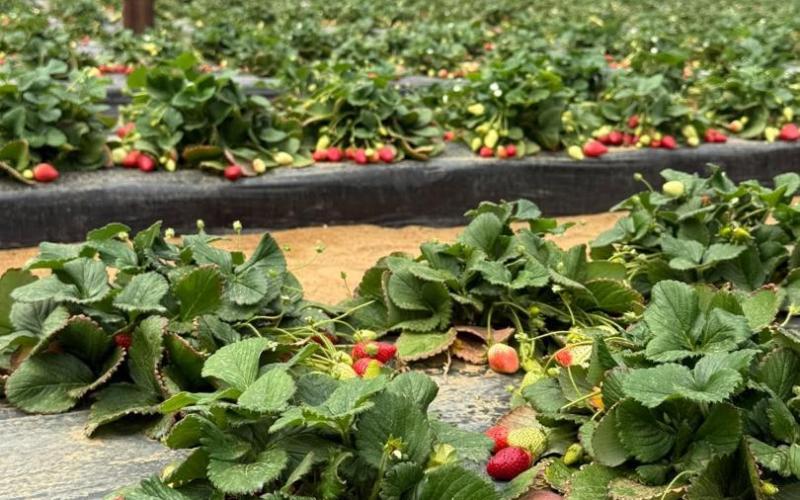
EdenBerry Strawberry Farm, about 60km south of Windhoek along the B1 towards Rehoboth, illustrates how agricultural enterprises can diversify their revenue streams.
Established by Richard and Desery van Wyk, the farm produces more than five tonnes of strawberries annually, supplying customers while processing fruit into jam and frozen products.
Its business model also incorporates agritourism. Visitors can pick and eat strawberries on the farm before paying for their harvest, while picnic facilities attract families and other groups.
Although strawberries are not an orchard crop, the model demonstrates how agricultural production can generate additional income through direct sales, processing and tourism.
Similar opportunities could emerge around commercial orchards through fruit-picking experiences, farm shops, hospitality facilities and locally processed products.
The NAB study found that only 49% of surveyed producers engaged in some form of primary processing, while 97% saw potential for expanding fruit production.
For Namibia, the challenge is to turn that potential into commercially viable orchards supported by irrigation, financing, storage, processing capacity and dependable markets.
Reducing the fruit import bill will require more than planting trees. It will require building an integrated domestic fruit industry that retains more agricultural value, creates employment and supplies consumers with locally grown produce.