Patience Makwele
First Gentleman Lt (Rtd) Epaphras Denga Ndaitwah has warned that Namibia needs a more coordinated approach to the challenges facing boys and men, citing a warning that “fragmented programmes were limiting their impact.”
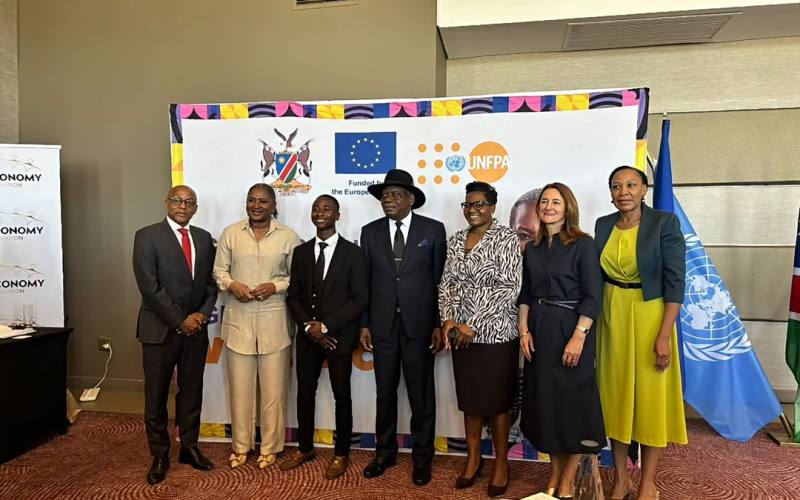
Ndaitwah was speaking at the Male Engagement Symposium in Windhoek on Wednesday, which was held under the theme “Coordinating Namibia’s Work with Men and Boys for Gender Equality and Wellbeing in Namibia”.
He said organisations working with men and boys were often operating in isolation, resulting in duplicated programmes and fragmented messaging.
“The power of coordination in male engagement programmes lies in its ability to transform uncoordinated, isolated efforts into unified, gender-transformative interventions,” he said.
Ndaitwah said interventions must also recognise that boys have different needs from girls.
“Boys and girls are equal in dignity, but not the same in their needs. A programme designed for girls cannot simply be renamed and handed to boys,” he said.
The call comes as government data continues to show disparities in boys’ educational outcomes.
Ministry of education statistics show that 17 152 learners dropped out of school in 2023, including 8 720 boys and 8 432 girls.
Research by the University of Namibia has also found that boys had lower promotion and survival rates and higher repetition, failure and school-leaving rates than girls over a prolonged period.
The study recorded an average promotion rate of 75.1% for boys, compared with 78.4% for girls. Boys also had a repetition rate of 18.5%, against 14.7% for girls.
However, the disparity continues into higher education.
Government’s Third National Gender Equality and Equity Policy 2025–2035 identifies male students as lagging behind and calls for measures to address the imbalance.
In 2020, men accounted for 22 715 of the 66 656 students enrolled in higher education, compared with 43,941 women. Male completion also fell from 34% in 2014 to 28.7% in 2020, while female completion rose from 66% to 71.3%.
Ndaitwah also raised concerns about the mental wellbeing of men and boys, pointing to what he described as a culture of silence around male mental health.
Police recorded 486 suicide cases during the 2025/26 financial year, of which 390 were adult men, 83 adult women, nine boys and four girls.
Ndaitwah said the figures formed part of a wider concern about the social, educational and psychological wellbeing of boys and young men.
He said he launched the DEN Impact Foundation on 18 August 2026 after recognising what he described as a “boy child crisis” in Namibia and globally.
The foundation’s focus includes sport, agriculture, technical training, skills development and character building.
Ndaitwah stressed that efforts to support boys should not come at the expense of gains made for girls and women.
Instead, he called for interventions that address the specific needs of both.
“The success of this dream must be squarely into your hands. You must be the own drivers of the agenda,” he said.
Gender Equality and Child Welfare Minister Emma Kantema said the symposium was aligned with the ministry’s Third National Gender Equality and Equity Policy 2025–2035 and its Strategic Plan 2025–2030.
The policy sets out a vision of a gender-just society where men, women, boys and girls enjoy equal rights and live with dignity.
Kantema also pointed to Namibia’s performance on gender equality, noting that the country ranks fourth globally and first in Africa in the World Economic Forum’s 2026 Global Gender Gap Index.
Chairperson of the Children’s Parliament Education and ICT Committee Gerson Neumbo said the symposium came at a critical time, particularly as concerns over boys’ educational outcomes persist.
Ndaitwah said Namibia had already shown what could be achieved through coordinated action during the HIV response.
“We did it with the HIV pandemic; we can do the same when we coordinate and work together in the boy child’s drive,” he said.
He called on government, civil society, schools, communities, traditional and faith-based organisations to leave the symposium with concrete commitments rather than discussions alone.