

Patience Makwele
Namibia has secured a place among the founding members of the newly established AI for Good Global Commission, putting the country at a global table where the future governance of artificial intelligence will be debated.
Information and communication technology (ICT) minister Emma Theofelus made the announcement on Friday at the official launch of the ninth National ICT Summit in Windhoek, saying Namibia could no longer afford to remain on the sidelines of the rapidly evolving AI revolution.
The commission was launched in July by the International Telecommunication Union (ITU), with Rwandan President Paul Kagame and Salesforce chair and chief executive officer Marc Benioff serving as co-chairs.
“Namibia is now a member of the Global AI Commission, chaired by President Kagame and the CEO of Salesforce, Mr Marc Benioff,” Theofelus said.
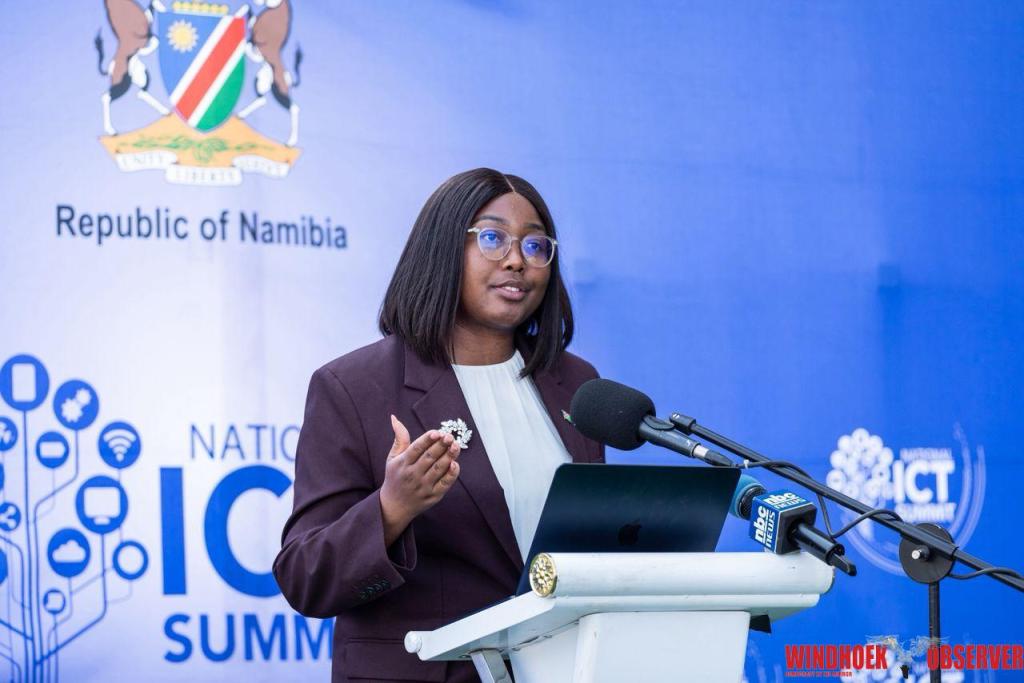
She said Namibia’s participation gives the country a seat at the global table where norms and standards around AI governance are being shaped.
“Namibia cannot afford to approach this conversation from the sidelines. We must ask ourselves how artificial intelligence can help us address our own challenges,” she said.
Theofelus said AI could improve public service delivery, support education and skills development, increase business productivity, assist farmers and other productive sectors and help the government make better decisions through data.
“AI is here. It is not going anywhere,” she said.
Deputy ICT minister Wenzel Kavaka said Namibia, like other developing nations, had entered a new phase of the digital revolution, with rapid advances in AI, automation, digital platforms, cloud technology and data analytics already reshaping industries, services and governance.
The remarks come as Namibia prepares to host the 9th National ICT Summit from 12 to 16 October at the Ongwediva Trade Centre in the Oshana region.
The summit, which will be held outside Windhoek for the first time, is themed “Harnessing ICT for Inclusive Growth: Digital Pathways to Reduce Unemployment and Eradicate Poverty.”
Linda Aipinge-Nakale, executive director and accounting officer of MICT, said taking the flagship summit beyond the capital reflected the ministry’s commitment to ensuring digital transformation reaches all parts of Namibia.
“Digital transformation must not be confined to the capital. It must reach every corner of Namibia, ensuring inclusivity and equal opportunity for all,” Nakale said.
She said the five-day summit would focus not only on infrastructure and software, but on how ICT can create jobs, empower young people and uplift communities from poverty.
Theofelus said technology should be viewed as an enabler across sectors rather than an end in itself.
“Technology itself is not a destination. It is a lever,” she said.
She said the real measure of digital transformation should be its impact on ordinary Namibians, including whether young people gain skills that enable them to earn an income, small businesses reach new markets and citizens access public services without travelling long distances.
The minister said Namibia should move beyond being a consumer of technologies developed elsewhere and create an environment where Namibians can build, own and export digital solutions.
A young developer in Keetmanshoop, she said, should be able to develop an application that reaches customers in Windhoek, Johannesburg, Nairobi or elsewhere in the world.
“This is how ICT becomes an instrument for employment creation,” she said.
Theofelus said technological change would transform the labour market, with some tasks increasingly performed by machines and AI while new occupations emerge.
She said Namibia therefore needed to move beyond basic digital literacy and develop skills in software development, data analysis, cybersecurity, digital entrepreneurship and problem-solving.
“We need to create pathways from learning to skills, to innovation, to enterprise, and ultimately to income and employment,” she said.
She also called for responsible adoption of emerging technologies, stressing the importance of trust, cybersecurity and data protection as Namibia expands its digital economy.
Meanwhile, MICT raised N$1.2 million in sponsorship for the upcoming summit from platinum, gold, diamond and silver sponsors, with additional contributions made in kind through technical expertise and partnerships.
Theofelus said the digital economy could not be built by government alone and called on the private sector, academia, civil society and other stakeholders to collaborate in developing solutions to Namibia’s challenges.
She urged summit participants to arrive with investment proposals, skills-development initiatives, technologies and partnerships rather than merely presentations.
“Come with solutions, come with partnerships, come with investment proposals, come with skills development initiatives,” she said.
The minister said the success of the summit should ultimately be measured not by attendance, but by the collaborations, businesses, investments, skills and solutions that emerge after the event.


