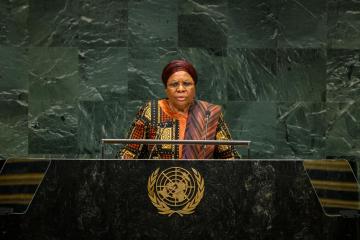
Justicia Shipena
Namibia is expected to submit its sectoral transformation investment plan (STIP) under the Climate Investment Funds Industry Decarbonisation Programme by October.
This is as the country pushes to unlock up to US$250 million (approximately N$4.7 billion) in concessional climate finance for low-carbon industrial development.
The investment plan aims to attract concessional finance and boost support from development finance institutions, multilateral banks, and private investors.
“This process is designed to help Namibia unlock catalytic concessional finance and crowd in further support from development finance institutions, multilateral development banks and private investors,” said Namibia Green Hydrogen Programme interim head Joseph Mukendwa during the launch of the African Green Industries Summit (AGIS) on Wednesday.
He said the STIP is not only about financing but also about building a national pipeline of projects that can move Namibia from planning into implementation.
“It is helping us identify which projects, infrastructure enablers, industrial opportunities and policy measures can move Namibia from planning into implementation,” he said.
Mukendwa said 78 projects and developers have already been shortlisted for further engagement.
“These projects fall under strategic themes such as clean energy and industrial power anchors; enabling infrastructure including grid, storage and system integration; industrial system decarbonisation and value addition; circular economy and low-carbon manufacturing; and bioeconomy, agriculture and climate innovation,” he said.
He said the projects show that Namibia’s green industrialisation plans stretch across sectors such as mining, agriculture, logistics, manufacturing, transport, water and technology.
Mukendwa described AGIS as a shift from discussions focused only on hydrogen to broader green industrialisation.
He said Namibia’s goal is not only to export green hydrogen products but also to use renewable energy and green hydrogen to drive industrial development, infrastructure expansion, skills development and value addition.
The summit will take place in September in Swakopmund under the theme ‘Powering African Industries for Sustainable Development’. The summit is organised by NEA Consulting.
Mukendwa said Namibia has already started seeing practical outcomes from earlier hydrogen summits through pilot projects linked to green iron, green hydrogen mobility, green ammonia, fertiliser production and renewable energy applications.
Mukendwa also called for stronger local participation in the summit, including youth, small businesses, training institutions and community representatives.
At the same launch, deputy minister of industries, mines and energy Gaudentia Kröhne said Namibia’s objective is to build a full industrial ecosystem linked to green energy and value addition.
“Our portfolio is fundamentally about enabling the productive transformation of the Namibian economy. It is about moving from extraction to value addition; from importing industrial capability to building it locally; from raw potential to structured economic growth,” Kröhne said.
The sixth National Development Plan (NDP6) aims to increase the contribution of secondary industry to 25% of GDP and manufacturing to 18% of GDP and create 30 000 green jobs by 2030.
“Green hydrogen is not treated as an end in itself, but as a platform for industrial transformation,” she said.
She said AGIS could help connect Namibia’s project pipeline with investors, development finance institutions and project developers needed to move projects into implementation.
She further announced that Namibia will participate in the upcoming World Hydrogen Summit in Rotterdam to market the country’s green industrialisation agenda internationally.
Kröhne stressed that AGIS should be viewed as more than a conference.
The acting chief executive officer of the Namibia Investment Promotion and Development Board (NIPDB), Jessica Hauuanga, said the inaugural AGIS 2026 is expected to help position Namibia as Africa’s green industrial hub while attracting investment and creating opportunities for local businesses and young people.
Hauuanga added that international conferences hosted in Namibia have strengthened the country’s reputation as a destination for global business events and investment gatherings.
She said NIPDB supports events that attract investment, create opportunities for small businesses and expose young people to future industries.
“Secondly, they enable full and meaningful participation for our local businesses, especially the small to medium enterprises, and for the youth, ensuring knowledge transfer and exposure to current and future opportunities in emerging sectors,” Hauuanga said.
She stressed that Namibia’s green industrial ambitions must deliver practical economic benefits.
She called on Namibians, investors, businesses, government institutions and the media to participate in the summit.