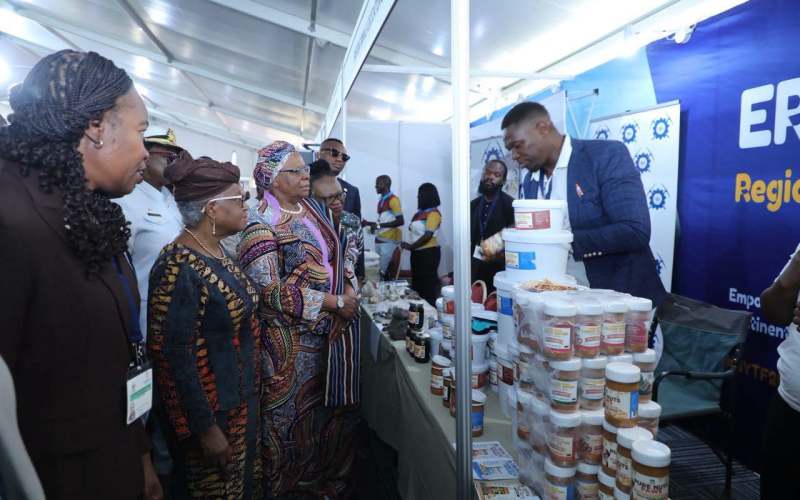
President Nandi-Ndaitwah challenges young entrepreneurs to access finance, enter industrial supply chains and expand into regional markets.
Elvis Mboya
President Netumbo Nandi-Ndaitwah has challenged young Namibians to move beyond seeking formal employment and establish businesses capable of supplying industries, processing local resources and competing in regional and international markets.
Officially opening the inaugural National Youth Trade Forum in Windhoek on 18 November, the President said, “Young people must become producers, innovators, entrepreneurs and active participants in the country’s economic development.”
The two-day forum, held under the theme Empowering the Youth to Access Local, Continental and International Markets, brought together young businesses from all 14 regions, financial institutions, investors and policymakers.
The initiative comes against a challenging employment background.
Namibia’s 2023 Population and Housing Census Labour Force Report puts youth unemployment among people aged 15 to 34 at 44.4%, compared with national unemployment of 36.9%, according to the Namibia Statistics Agency (NSA).
Financing gap tests youth enterprise ambitions
The National Youth Development Fund (NYDF) has become one of the government’s principal instruments for addressing financing constraints facing emerging businesses.
At the forum, Nandi-Ndaitwah announced that the fund had grown to N$422 million following an additional N$165 million mobilisation from the Namibia National Reinsurance Corporation.
She also reported that projects financed through the initiative had generated more than 700 jobs during its initial months of operation.
The fund operates through the Development Bank of Namibia, Agribank, NamPost and the Environmental Investment Fund, providing collateral-free financing to young entrepreneurs.
Earlier ministry of finance figures showed that by the end of August 2026, the fund had received 13 809 applications, approved N$135 million in financing and disbursed N$90.8 million.
The government had initially allocated approximately N$257 million to the programme.
The difference between approvals and disbursements highlights the challenge of converting financing commitments into operating businesses.
Other government interventions include the Equipment Aid Scheme, MSME Development Fund and entrepreneurship training programmes.
Dangote investment creates supply-chain opportunities
The President identified the Dangote Namibia Tank Farm and Regional Pipeline Project as an opportunity for young businesses to participate in major infrastructure investment.
The US$2.5 billion project, equivalent to approximately N$41 billion at its launch, was inaugurated at Farm 58 in Walvis Bay on 4 November.
It includes a planned 600-million-litre petroleum storage facility and a proposed 1,700-kilometre regional pipeline network.
The storage facility is designed for 360 million litres of diesel and 240 million litres of petrol, with construction expected to take approximately 18 to 20 months.
The investment presents potential opportunities for construction contractors, engineering firms, transport operators, equipment suppliers and maintenance businesses.
Nandi-Ndaitwah urged young entrepreneurs to develop technical skills, establish partnerships and understand procurement requirements to compete for contracts.
However, participation will depend on financial capacity, technical competence and compliance with industry standards. Subcontracting and joint ventures could provide entry points for smaller Namibian enterprises.
Value addition and regional trade
The President also challenged young entrepreneurs to invest in processing and manufacturing rather than concentrate on exporting unprocessed commodities.
She identified minerals, fish, beef and agricultural products as areas where businesses could create additional value through processing, packaging, branding and manufacturing.
Namibia’s economic structure illustrates the opportunity. According to the Food and Agriculture Organisation, primary industries contributed 16.2% of GDP in 2024.
Mining and quarrying accounted for 9.7%, agriculture and forestry 3.7%, while fishing and fish processing on board contributed 2.8%.
Secondary industries contributed 19.1% of GDP. Meat processing accounted for 0.5%, while onshore fish processing contributed 0.15%, according to FAO in Namibia
These figures point to opportunities in meat processing, fish products, agricultural manufacturing and mineral beneficiation.
However, expanding into these industries requires machinery, reliable electricity, cold storage, certification, distribution networks and working capital.
Nandi-Ndaitwah further urged young businesses to explore markets beyond Namibia through the African Continental Free Trade Area (AfCFTA) and other regional trade agreements.
AfCFTA offers access to a continental market of more than 1.3 billion people, potentially allowing Namibian enterprises to expand beyond the domestic market of approximately three million people.
She also encouraged digital commerce, noting that online platforms provide opportunities to reach international customers without establishing physical outlets abroad.
Formalisation critical to business growth
The President emphasised the importance of business registration, proper financial records, brand protection and mentorship in improving access to finance and larger markets.
She encouraged cooperation through cooperatives, business associations and joint ventures, particularly where individual enterprises lack the capacity to pursue larger commercial opportunities.
The ministry of international relations and trade said the forum followed outreach engagements across all 14 regions to identify investment opportunities and position locally produced goods for export.
For Namibia, the economic test will be whether youth-owned enterprises can translate financing into productive capacity, secure contracts from major investments, expand manufacturing and generate sustainable employment.
The success of the initiative will ultimately depend on businesses moving beyond registration and accessing the markets, capital and supply chains needed to grow.