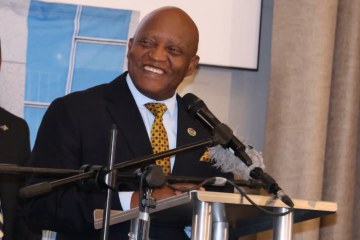
Sostenus Wilherm
Education minister Sanet Steenkamp has revealed that NSFAF received 56 075 applications this year, with 38 419 approved for funding, while 17 586 others remain at different stages of the validation process or have been unsuccessful.
The figures were presented by Steenkamp in the National Assembly on Thursday to provide the clearest indication yet of the volume of applications being handled by the Namibia Students Financial Assistance Fund (NSFAF), as students continue to raise concerns over delayed financial assistance, particularly non-tuition payments.
Steenkamp was responding to IPC member of parliament Bertha Nghifikwa, who questioned the continued delays in non-tuition payments and reminded Steenkamp that she had previously committed to completing the disbursement by July.
Nghifikwa said students were now facing eviction and struggling to survive because they had not received their allowances.
Steenkamp said NSFAF had received 56 075 applications to date but stressed that the validation and award process was still ongoing.
“Now, I also wish to state that to date, we had 56,075 applicants for NSFAF. The validation process is something that is ongoing.”
Of the 56 075 applications, 38 419 have been approved for funding, with invoices requested from institutions for disbursement.
This leaves 17 586 applications that have not yet reached the approved stage, although Steenkamp’s breakdown places these applications into different categories rather than describing all of them as pending.
According to the Minister, 9 325 students applied but were required to resubmit certain documents, while 1 845 validations were still in process.
A further 6 416 applications were unsuccessful because of non-compliance, ineligibility or a lack of credible supporting documents.
“9,325 students applied, but they have to resubmit certain documents. The credible supporting documents have not been submitted for many of them and are lacking. 1,845 validations are still in process,” Steenkamp said
Steenkamp added that the 6 416 unsuccessful applications were linked to students who did not meet the funding requirements or failed to provide the necessary documentation.
“Out of these 56 075, there are 6 416 applications that were unsuccessful. These are due to non-compliance, or students not eligible for funding, or a lack of credible supporting documents.”
The figures come against the backdrop of a growing dispute over delayed non-tuition payments.
Nghifikwa told Parliament that the minister had previously attributed delays to mistakes in application forms from new applicants and had later announced a N$247 million injection into NSFAF to help clear the backlog.
She said both new and continuing beneficiaries had been affected and demanded an explanation for why students were still waiting in September.
“We are now in September and most of the students do not receive or did not receive their non-tuition fee. As a result, Madam Speaker, most of them are facing eviction and many have resulted in desperate measures just to survive,” Nghifikwa said.
Nghifikwa also pressed the ministry for timelines that students could rely on and asked what would be done to protect beneficiaries who were facing eviction while waiting for their allowances.
“Since the students were all affected, what is the true cause of delay? And also to give us realistic timelines that are measurable and attainable.”
Steenkamp explained that NSFAF had introduced three application periods this year, increasing the opportunities for eligible students to apply for assistance.
The first application period ran from January to March, the second from May to June, while the third opened on 7 September and will close on 7 October.
“The first one ran from January until March. The second one ran from May to June. And the third one is now in place from 7th September to 7th October,” Steenkamp said.
The latest application window is aimed at qualifying students who are already enrolled at universities but did not previously apply for NSFAF funding.
Steenkamp said the continuous intake of applications was one of the reasons the validation and award process remained ongoing.
“Now, I said that the validating and the award processing is something that remains ongoing. Because we constantly receive new applications.”
Steenkamp also provided a separate breakdown of continuing students and new intakes. She said 42 219 continuing students are funded, while institutions had submitted invoices for 28 869 new-intake students.
For continuing students, NSFAF has paid N$1.3 billion, comprising N$835 million in tuition fees and N$445.2 million in non-tuition payments. The Minister said payments had been made to 37 186 continuing students.
“To date, we’ve paid $1.3 billion for all continuing students. The tuition fees are $835 million, just this year. And for non-tuition, we’ve already paid $445.2 million.”
For new-intake students, Steenkamp said NSFAF had disbursed N$717 million, including an advance payment made earlier in the year to public and private institutions. She clarified that the amount was tuition funding, including N$628 million paid at the beginning of the year.
“A total amount, including the advance that we gave in the beginning of the year to public and to private institutions, a total amount of $717 million has been disbursed for new intake,” Steenkamp said.