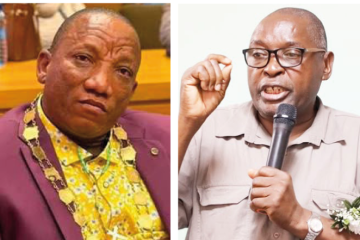
Patience Makwele
The Livestock Producers’ Organisation (LPO) vice-chairperson, Dawie Kok, says no country can successfully fight foot-and-mouth disease (FMD) in isolation.
He said this as Namibia strengthens efforts to protect its livestock industry from the growing regional threat.
Kok said Namibia’s internationally recognised FMD-free status remains an achievement worth protecting, but maintaining it requires cooperation between governments, veterinary authorities, farmers and regional partners.
“Our FMD-free status is something we can be proud of, but it brings with it a greater responsibility not only towards ourselves but also towards the region of which we are a part,” Kok said.
His remarks come as Southern African countries step up efforts to contain the spread of transboundary animal diseases that threaten livestock production, agricultural trade and rural livelihoods.
For Namibia, protecting its FMD-free status is critical to maintaining access to international beef export markets. An outbreak could result in trade restrictions, financial losses and disruptions across the livestock sector.
The government has already strengthened disease prevention measures following FMD outbreaks reported in South Africa and parts of Botswana earlier this year.
In February, minister of agriculture, fisheries, water and land reform Inge Zaamwani told Parliament that authorities had intensified disease prevention measures along Namibia’s southern border.
She was responding to questions from Popular Democratic Movement (PDM) member of parliament Diederik Vries when she said the ministry had increased spraying operations at border points and was closely monitoring developments in neighbouring countries.
The ministry also continued awareness campaigns aimed at encouraging farmers and other stakeholders to remain vigilant while avoiding the spread of misinformation about the disease.
Earlier this month, agriculture officials launched a nationwide information campaign to educate livestock producers and communities on FMD prevention and control measures.
In March, the government introduced further biosecurity measures by declaring an FMD control area within Namibia’s FMD-free zone in the ||Karas region.
The declaration, published in the government gazette on 17 March, established a precautionary control zone near the South African border, stretching from areas around the Mata-Mata border post to sections of the Orange River.
The ministry stressed that the declaration did not mean there was an outbreak in Namibia. Instead, it was introduced to reduce the risk of disease entering the country and to protect Namibia’s export status.
At the time, Zaamwani urged farmers to remain alert and strengthen biosecurity measures on their farms.
She urged farmers to properly disinfect vehicles transporting livestock and avoid using them in disease-affected areas.
Regional cooperation has also become a growing focus in efforts to contain the disease.
South Africa and Botswana recently adopted a Joint Action Plan for 2026 to 2028 aimed at improving cooperation in the fight against FMD and other transboundary animal diseases.
The agreement includes coordinated vaccination programmes, disease surveillance, stronger diagnostic systems, border fence maintenance, livestock traceability measures and farmer training.
The two countries also agreed to establish a Transboundary Animal Disease Plan for key border areas and a Cross-Border Stock Theft Management Task Force to improve coordination and curb illegal livestock movements.
South African agriculture minister John Steenhuisen said regional cooperation remains essential in the fight against the disease.
“With FMD posing an ongoing regional threat to livestock production, rural livelihoods and agricultural trade, it is clear that no country can defeat this disease in isolation,” he said.
Kok echoed those concerns, saying livestock producers across Southern Africa face similar challenges, including disease outbreaks, climate pressures and economic uncertainty.
He said governments, veterinary authorities and farmers must continue working together to protect the future of agriculture in the region.
“May we continue to stand together and may we never forget that the future of agriculture in Africa is not protected by one farmer or one country but by all of us standing together,” he said.