The renewed tensions surrounding a decades-old land dispute in the Zambezi Region should serve as a serious warning to Namibia: land disputes, particularly those involving families, traditional authorities and communal land, must be dealt with legally, cautiously and timeously before they escalate beyond the ability of institutions to contain them.
The dispute involving the Jimu, Muninjahi, Ndivi and Jojo families is not new. It has moved through traditional structures and formal courts for decades, with records reportedly dating as far back as 1927. Various decisions have been made over the years, including rulings by traditional authorities, appeals under customary structures and proceedings before the formal courts.
Yet the dispute remains capable of generating confrontation.
That is the most worrying aspect.
According to the Masubia traditional authority, a meeting held on 14 September became quarrelsome despite the presence of police and security officials. There were subsequently reports of further confrontation and alleged damage to crops and farms on the disputed land.
These developments should not be dismissed as merely another chapter in a long-running family disagreement.
Land is deeply connected to identity, livelihood, family history and dignity. In communal areas, land is not simply an economic asset. It can represent ancestral ties, social belonging and the future security of families. When people believe that their land or heritage is under threat, emotions can run high.
That is precisely why land disputes require particularly careful handling.
The Masubia Khuta appears to recognise this danger. Senior induna Albius Mwala reportedly said police were deliberately brought into the September meeting because previous gatherings had become confrontational. He also warned that the situation could have become much worse had security officials not intervened.
Such warnings should never be ignored.
The objective must be to prevent a land disagreement from becoming a security problem, a community conflict or, most tragically, a source of injury or loss of life.
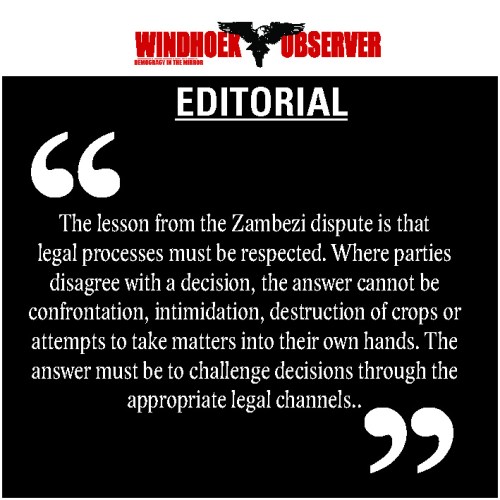
The lesson from the Zambezi dispute is that legal processes must be respected. Where parties disagree with a decision, the answer cannot be confrontation, intimidation, destruction of crops or attempts to take matters into their own hands. The answer must be to challenge decisions through the appropriate legal channels.
Equally important, however, is the responsibility of the institutions that administer justice and land.
When disputes remain unresolved for years or decades, the danger is that legal uncertainty itself becomes a source of tension. Communities need to know where they stand. Families need clarity. Traditional authorities need clarity about the limits of their jurisdiction. Government departments need clarity about their responsibilities. And court decisions must ultimately provide an authoritative basis for moving forward.
The High Court record cited in this case illustrates the complexity that can develop when customary and statutory processes intersect. A 1997 ruling by the Bukalo Royal Khuta was later overturned by an appellate body under Masubia customs and traditions. A subsequent decision by the Zambezi Communal Land Board appeal tribunal was itself challenged and later set aside by the High Court.
Whatever the merits of the competing claims, this history demonstrates why land disputes cannot simply be allowed to drift from one institution to another without a clear and final legal pathway.
It is also important to distinguish between a party’s right to challenge a decision and a right to ignore it.
They are not the same.
A person or family who believes a decision is wrong should have access to a fair legal mechanism to challenge it. But until such a decision is lawfully overturned, parties must respect the applicable legal position.
This is where traditional authorities, government and the courts have an important role to play.
Traditional authorities remain significant custodians of customary law and community stability. But where a matter has moved beyond their jurisdiction, as the Masubia Khuta says this dispute has, the authority should not be placed in the impossible position of repeatedly attempting to resolve something that properly belongs before another institution.
Likewise, government cannot be expected to repeatedly intervene in disputes that have already passed through established legal processes simply because one or more parties remain dissatisfied.
But government also has a responsibility to ensure that the legal and administrative systems dealing with communal land are accessible, understandable and sufficiently responsive to prevent disputes from becoming entrenched.
There is an urgent need for a culture of early intervention.
The longer a land dispute remains unresolved, the more difficult it can become to separate the original legal question from accumulated grievances, family divisions and competing claims. People grow older, generations become involved, property is developed, crops are planted and new interests emerge. What may have begun as a relatively straightforward boundary disagreement can eventually become an intensely emotional conflict involving entire communities.
That is why land disputes should be addressed as early as possible.
The Zambezi case should therefore not only concern the four families involved. It should prompt a broader national conversation about how Namibia manages communal land disputes.
There must be mechanisms for early mediation where appropriate, clear records of traditional and formal decisions, accessible appeal processes and effective communication between traditional authorities, local authorities, land boards, government departments and the courts.
Most importantly, there must be no ambiguity about the rule of law.
Namibia cannot afford for disagreements over land to become settled through confrontation. Nor can the country afford situations in which people believe that the only way to protect their interests is to physically occupy disputed land, destroy another person’s crops or confront their opponents.
The reported calls for peace from people involved in the dispute should therefore be taken seriously. The statement that families are tired of fighting should resonate beyond the Zambezi.
Nobody wins when a land dispute becomes a source of fear.
The ultimate objective of every legal and traditional process must be to establish a lawful resolution that communities can live with, even where individual parties remain disappointed by the outcome.
The Zambezi dispute has already consumed decades.
Namibia should ensure that it does not consume another generation, or, worse, result in preventable violence.
Land disputes must be handled early, lawfully, patiently and decisively. Once emotions turn into confrontation, restoring peace becomes far more difficult.
The time to prevent that escalation is before the first blow is struck, not after the damage has been done.