Patience Makwele
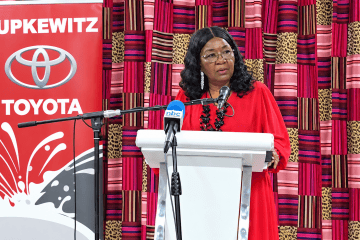
Home affairs, immigration, safety and security minister Lucia Iipumbu has warned new correctional officers not to abuse their power.
She spoke at the 32nd Basic Training Graduation Ceremony of the Namibian Correctional Service, where 399 recruits graduated on Thursday.
Iipumbu said officers must treat inmates with dignity.
“No officer is made stronger by mistreating an inmate. No institution is made safer by violating human dignity. You have earned the right to wear the uniform, but you must now earn the trust that comes with it every single day,” she said, adding that the uniform is a symbol of lawful authority, national duty, discipline and public trust.
She said the job will test officers’ judgement, especially when dealing with difficult situations.
Her warning comes as the correctional service operates at about 30% of its required staff.
The system is under pressure from staff shortages, ageing facilities and a lack of specialists such as psychologists and doctors.
While welcoming the new officers, Iipumbu said discipline must remain a priority.
“Numbers must be matched by discipline, character and conduct,” she said.
Iipumbu said there has been some progress, including rehabilitation programmes.
Between April 2025 and March 2026, nearly 2 000 inmates joined training and education programmes, with more than 1 500 completing them.
She said integrity remains key.
“No budget can replace integrity. No infrastructure can replace discipline. No policy can replace professionalism,” she said.
Legal analyst Alfred Matjiua Tjitunga said the situation is extremely serious and raises major legal concerns. He noted that the state has a responsibility to ensure safe and humane detention conditions, warning that operating at about a third of the required capacity significantly increases the risk of rights violations.
“Abuse does not always happen because someone intends it; it often happens because systems are under pressure. When officers are overworked, supervision weakens and tensions escalate. That’s when you start seeing excessive force, neglect or procedural shortcuts,” Tjitunga said.
He said strong oversight is needed.
“You need robust internal oversight, independent complaints mechanisms and regular inspections of facilities. In an understaffed system, accountability becomes even more important, not less,” he said.
Head of the Namibian Correctional Service (NCS) commissioner general Raphael Tuhafeni Hamunyela urged recruits to act professionally.
“The standard you set from your first day in service will define not only your career but also the reputation of the institution,” he said.
Human rights activist Rebecca Moola Inambao said staff shortages make it harder to protect inmates.
“We often hear strong commitments to dignity and humane treatment, but those principles are hardest to uphold when resources are stretched thin. Without adequate staffing and oversight, accountability becomes difficult,” she said.
Recent cases have raised concern about safety in detention centres. In March 2025, an inmate in Keetmanshoop was stabbed 13 times by other inmates. Police also recorded 24 cases of rape or sodomy in holding cells during the 2023/24 financial year.
At least 57 inmates are suing the correctional service over alleged abuse.
A former inmate said staff shortages were clear.
“You could see the officers were tired and overwhelmed,” he said. “Sometimes they were fair, but other times frustration took over. When there aren’t enough people on duty, things can escalate quickly, and a lot of times when such cases are reported, they sound sensationalised, but it is the actual truth. These people are not enough to stay alert during shifts and it puts the lives of inmates at stake.”
Criminology researcher Nalooliwa Geraldine Nghipandulwa said the system faces deeper challenges.
“You cannot talk about rehabilitation in a meaningful way if your system is overstretched. Officers end up focusing on containment rather than correction and that defeats the purpose of the institution,” she said.
She warned that legal action could increase.
“The biggest risk is systemic litigation, cases where inmates or advocacy groups challenge conditions of detention. If courts find that the state is failing to meet minimum standards, it could lead to orders for reform, compensation claims or increased judicial oversight,” she said.