CHAMWE KAIRA
Germany committed €43.8 million, equivalent to about N$822 million, to development projects in Namibia in 2025, covering sustainable urban development, vocational training, green and sustainable energy, and sustainable natural resource management.
The funding forms part of a portfolio of more than 50 projects implemented through Germany’s KfW Development Bank, GIZ and the Federal Institute for Geosciences and Natural Resources (BGR).
The funding comprises a combination of grants and concessional loans. The two governments have also expressed interest in exploring innovative development financing instruments as they deepen their development cooperation.
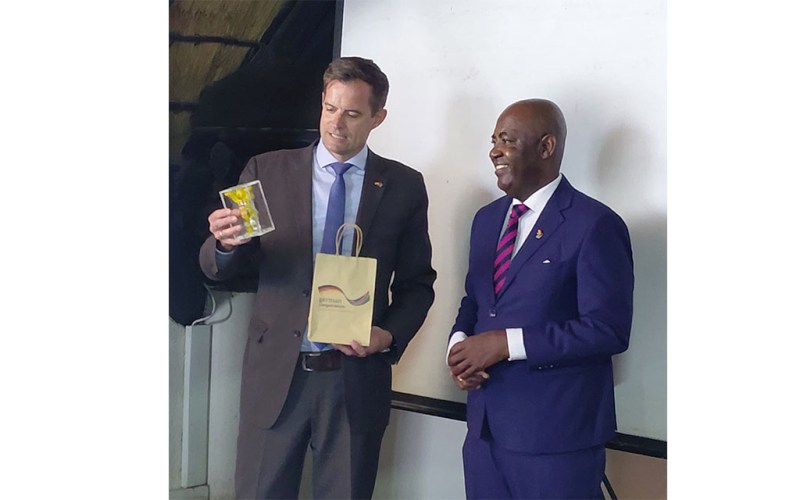
The commitments were highlighted during the Namibia-Germany Strategic Dialogue held in Opuwo in September, where the two countries agreed to strengthen cooperation in climate resilience, water security, biodiversity, a just green energy transition and skills development.
The governments said the cooperation would focus on two main areas: advancing climate-resilient water security, biodiversity and livelihoods, and harnessing Namibia’s potential for a just green energy and skills transformation.
The partnership is intended to support green industrialisation, expand trade and investment opportunities between Namibia and Germany, and create employment while addressing climate and livelihood concerns.
Germany and Namibia have maintained development cooperation for more than 35 years, dating back to Namibia’s independence in 1990.
According to the two governments, Germany has been Namibia’s most important single development partner and Namibia is the largest recipient of German development cooperation in Africa on a per-capita basis.
Past cooperation has included support that secured 283 000 livelihoods across communal conservancies and the expansion and rehabilitation of the Ruacana Hydropower Plant, which has a total capacity of 437 megawatts.
The governments also highlighted results achieved in six areas of cooperation: renewable energy, sustainable urban development, biodiversity, water, technical and vocational education and training, and private sector and financial sector development.
The areas are aligned with Namibia’s Sixth National Development Plan (NDP6), particularly its pillars on economic growth, transformation and resilience; human development and community resilience; and environmental sustainability.
Under the renewed cooperation, Namibia and Germany intend to strengthen climate-resilient access to safe water and the sustainable management and conservation of biodiversity.
The cooperation will also support climate change adaptation, particularly in rural communities, with the aim of protecting livelihoods and ecosystems.
In the energy sector, the two governments agreed to continue supporting Namibia’s transition towards a green economy and to harness the country’s potential for socio-economic and ecological transformation.
Germany and Namibia will also continue strengthening labour-market-oriented technical and vocational education and training.
The governments said the skills programmes are intended to enable more women and men, particularly young people, to access employment opportunities in Namibia’s emerging green economy.