CHAMWE KAIRA
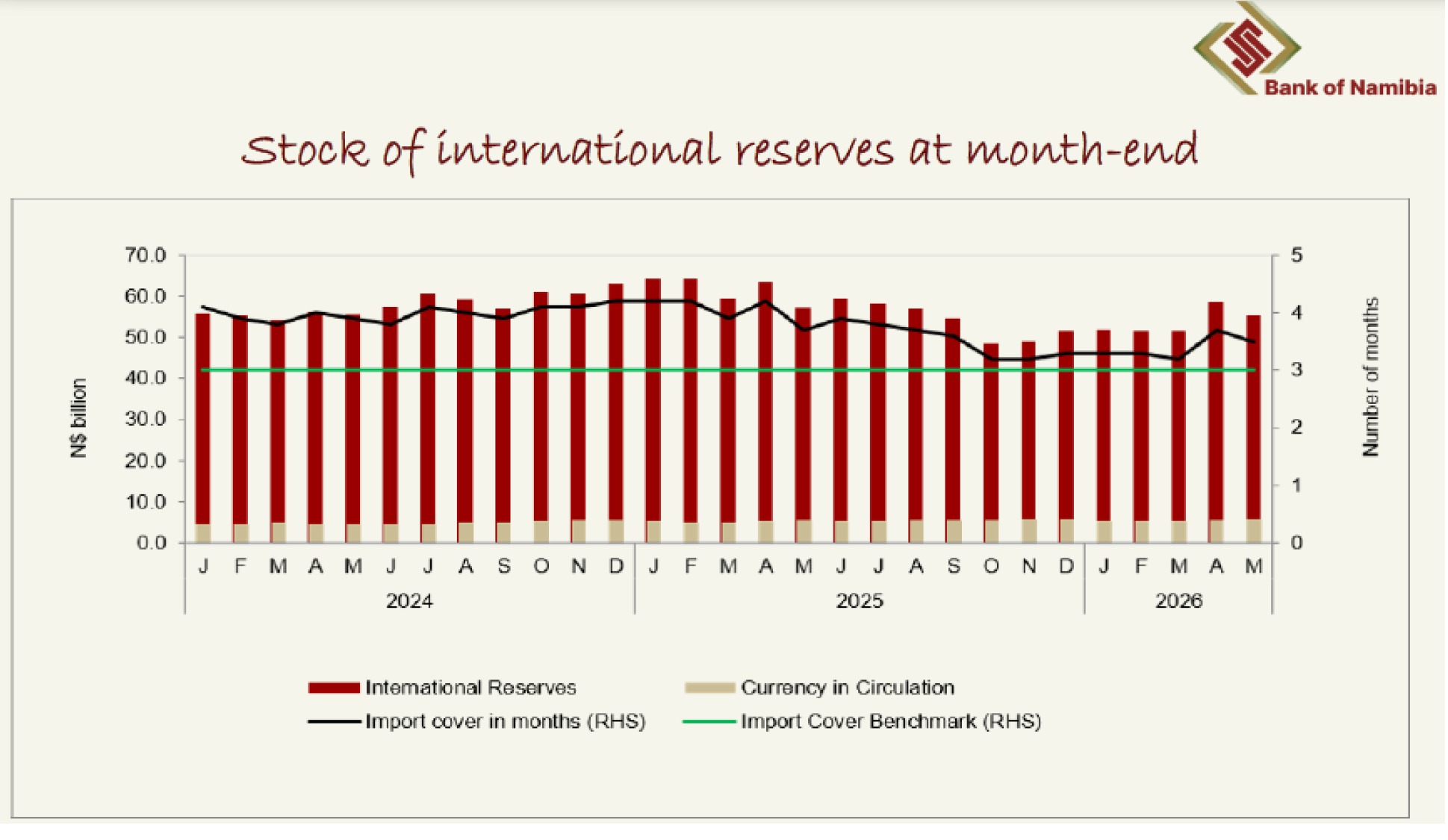
Namibia’s official stock of international reserves declined by 5.8% at the end of May, falling to N$55.4 billion, mainly due to net South African rand (ZAR) outflows, according to the latest monetary data.
The Bank of Namibia said the decline in reserves was largely driven by net ZAR outflows through commercial banks, compounded by customer foreign currency withdrawals and foreign payments made by the government.
Despite the decline, the reserve position remained sufficient to cover an estimated 3.5 months of imports, or 3.8 months when oil and gas exploration and appraisal-related imports are excluded.
The reserves were also equivalent to 9.5 times the value of currency in circulation, which the central bank said was adequate to maintain the Namibia dollar’s peg to the South African rand and meet the country’s short-term international obligations.
Meanwhile, liquidity in the banking sector strengthened during the month. The banking industry’s overall cash position rose 27.0% to N$10.7 billion in May from an average of N$8.4 billion in April.
The increase was attributed mainly to diamond sales proceeds, government spending and investment flows.
Private sector credit extension (PSCE) slowed during the month, with the total loan book reaching N$124.2 billion.
Annual credit growth eased to 4.3% in May from 4.8% in April, reflecting weaker borrowing by businesses while household credit growth remained unchanged.
Business credit growth slowed to 4.4% from 5.5% in April, mainly due to net repayments of overdrafts and other loans by companies in the mining, manufacturing and telecommunications sectors.
Household credit growth remained steady at 4.2% year-on-year. While household overdraft lending recorded a slight increase, this was offset by slower growth in instalment sale and leasing finance, as well as other loans and advances.
Overdraft lending across the economy also lost momentum. Annual overdraft credit growth declined to 6.0% in May from 11.4% in April, largely because businesses in the mining, manufacturing and telecommunications sectors repaid outstanding facilities. Household overdraft growth, however, edged slightly higher.
Mortgage lending recorded modest improvement during the month. Annual mortgage credit growth increased to 1.6% in May from 1.2% in April.
The improvement was driven by business mortgage lending, which returned to positive growth of 0.3% after contracting by 1.0% in April. Mortgage credit extended to households remained unchanged at 1.9%.
Instalment sale and leasing credit continued to expand, with annual growth accelerating to 22.2% in May from 20.6% in April.
The increase was mainly driven by higher uptake by businesses and sustained demand for new vehicles, whose annual growth accelerated to 15.8% from 6.2% in the previous month.
Broad money supply (M2) also continued to expand, with annual growth rising to 12.1% in May from 10.5% in April.
The Bank of Namibia said this represented the strongest M2 growth since July 2020 and was supported by robust domestic claims growth of 17.0%.
Although the contraction in net foreign assets narrowed to 4.2% from 6.6% in April, the central bank noted that May marked the eighth consecutive month of negative net foreign asset growth since October 2025.