As Namibia prepares to launch Dangote’s petroleum project today (Wednesday), the proposed infrastructure and Angola’s Lobito refinery offer new routes to fuel security. Whether either can lower pump prices will depend on the cost of supply, financing and execution.
Elvis Mboya
Namibia’s fuel security debate takes on new significance today (Wednesday) as President Netumbo Nandi-Ndaitwah officially launches the Dangote Namibia Tank Farm and Regional Pipeline Project at Farm 58, outside Walvis Bay.
The launch comes as motorists face another fuel price increase, renewing scrutiny of the country’s dependence on imported petroleum products, shipping costs and port logistics.
A potential investment in Angola’s Lobito refinery presents a second opportunity to diversify supply.
Effective Wednesday, 4 November, petrol increases by N$2 per litre and diesel by N$3. Petrol 95 at Walvis Bay rises to N$28.58, Diesel 50ppm to N$30.86 and Diesel 10ppm to N$30.96.
The increase comes despite a slight easing in international petroleum prices. The Minister of Industries, Mines and Energy, Modestus Amutse, has cited a 40% rise in shipping costs and a 64% increase in vessel waiting costs, alongside exchange-rate pressures.
The figures highlight the growing cost of transporting, receiving, storing and distributing imported fuel.
Dangote’s Namibia connection
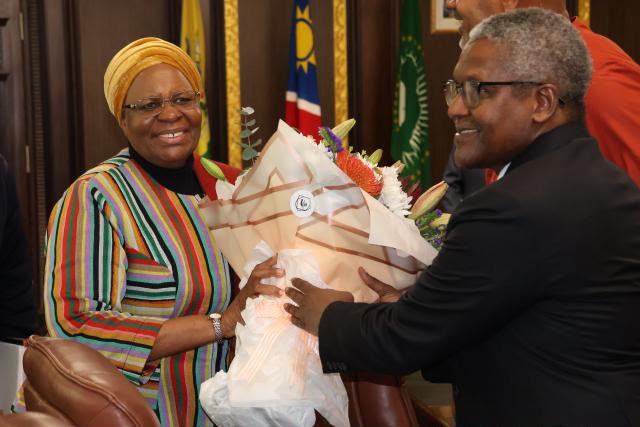
Dangote’s interest in Namibia dates back to his meeting with President Nandi-Ndaitwah at State House in Windhoek on 19 June 2025. The engagement explored potential investment opportunities in Namibia.
Dangote highlighted his group’s presence in more than 12 African countries and its 650 000-barrel-per-day Nigerian refinery.
“We are also exploring opportunities in other African countries with phosphate resources to expand fertiliser production and related value chains,” he said.
President Nandi-Ndaitwah welcomed the engagement, saying: “Meeting successful African entrepreneurs like yourself serves as a true inspiration for young Africans to play their part in the continent’s development.”
The Walvis Bay project is expected to include a petroleum storage facility with capacity for at least 1.6 million barrels of petrol and diesel.
Plans also include dispensing tanks, a truck port and a 16-kilometre pipeline connecting the fuel jetty, according to reports ahead of Wednesday’s launch.
The wider regional ambition is considerably larger. Dangote has outlined a proposed network of approximately 2 500 to 2 650 kilometres, estimated to cost more than US$3.5 billion, linking Namibia through Botswana towards South Africa, with another corridor through Zimbabwe and Zambia to the Democratic Republic of Congo.
For Namibia, the commercial opportunity extends beyond domestic supply. A regional distribution hub could generate storage revenue, pipeline tariffs, port activity and demand for logistics services.
Can it lower fuel prices?
Larger consignments, strategic storage and more flexible procurement could reduce exposure to vessel scheduling disruptions and emergency purchases.
However, infrastructure does not automatically translate into cheaper fuel. International product prices, exchange rates, insurance, financing, operating expenses and supply contracts will continue to influence landed costs.
There is also an important distinction between launching the project and completing it. The Farm 58 environmental process has involved land subdivision, while construction of the storage facility requires further environmental approval.
Angola’s Lobito refinery alternative
Namibia is also considering a potential equity investment in Angola’s Lobito refinery, following an invitation from President João Lourenço during Nandi-Ndaitwah’s state visit in October 2026.
The refinery, being developed by state-owned Sonangol, is designed to process 200 000 barrels of crude oil daily.
Angola has indicated that shareholder countries could receive priority access to refined products.
However, Namibia’s participation remains exploratory. Presidential spokesperson Jonas Mbambo said an invitation did not constitute a formal investment proposal or a government decision.
The two opportunities offer different commercial propositions. Dangote’s model centres on storage, distribution and regional fuel trading, while Lobito offers potential equity participation in refining capacity.
Any investment in Angola would require scrutiny of construction financing, shareholder rights, expected returns and the price at which products would be supplied.
The economics of fuel security
The National Energy Fund faces further pressure from fuel under-recoveries, with the government expecting to spend approximately N$384 million covering October’s shortfall.
With Namibia consuming about 100 million litres of fuel monthly, higher import costs and supply disruptions affect transport operators, mining companies, farmers and households.
Both proposals could diversify supply arrangements and strengthen Namibia’s position in regional petroleum trade. Neither, however, would insulate domestic prices from international market movements.
Ultimately, the test is whether these investments deliver more reliable supply at a lower total cost, while providing value for public money and strengthening Namibia’s long-term energy security.