Patience Makwele
The Kavango Traditional Leaders Forum has asked the government to intervene in Bravo and evict people who have settled in an area traditionally occupied by the San community, while also calling for portions of Bwabwata National Park and underutilised land at Mangetti to be made available for farming.
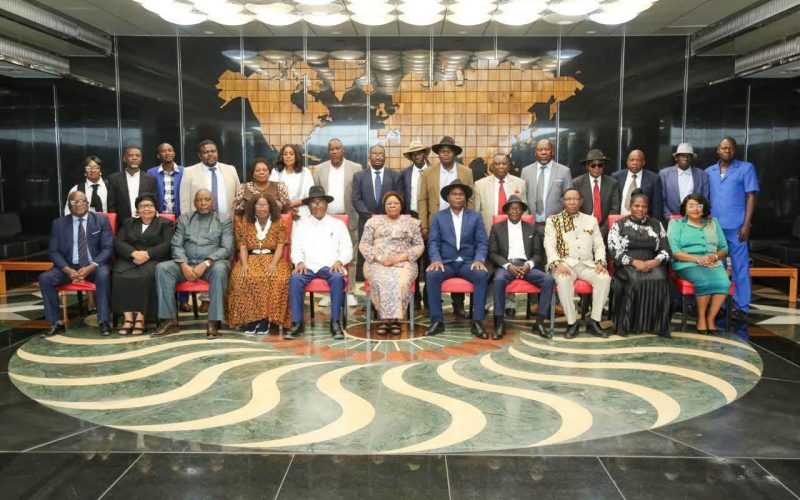
The requests were raised during a meeting with President Netumbo Nandi-Ndaitwah State House on Monday.
The leaders also raised concerns about the deteriorating condition of the Mashare Agricultural Project, poor rural roads, healthcare shortages and inadequate education facilities.
Forum chairperson and Uukwangali Traditional Authority leader Hompa Eugene Kudumo said the delegation had asked the government to intervene in Bravo because the San community was uncomfortable with the growing number of people settling in the area.
He described Bravo as the “area where the San community lives” and said the delegation had asked for those who had moved into the area to be evicted.
Kudumo did not explain the status of the people he said should be evicted. The President did not publicly respond to the specific request.
The forum also wants parts of Bwabwata National Park degazetted to allow communities to benefit from the land and establish farms. Kudumo said the Hambukushu community wanted some areas of the park released for these purposes.
The delegation further called for underutilised land at Mangetti to be surrendered to traditional authorities for allocation to individuals interested in farming.
“If the land is not utilized, why can’t they surrender some of the land to the traditional authority, and we give it to individual people for farming?” he said.
Kudumo said population growth and young people seeking to enter agriculture were increasing pressure on communal land, making it difficult for those who wanted to start farming to access land.
The request involving Bwabwata comes against the background of a longstanding dispute over land use in the park.
The Hambukushu Traditional Authority petitioned the National Assembly in 2021, seeking a review of a 1999 Cabinet decision prohibiting cattle in national parks in north-eastern Namibia and challenging the park’s 2007 proclamation.
A parliamentary committee visited the area in 2022 and heard concerns involving the Hambukushu and Khwe communities living in the park.
The Legal Assistance Centre also raised concerns that the rights and presence of the Khwe San community needed to be considered in discussions about the land.
Kudumo said the delegation also raised the condition of the Mashare Agricultural Project, which he said had previously provided opportunities for people to study and receive agricultural training.
He said the facility was deteriorating and no longer being used for its intended purpose.
“It is not used as it’s supposed to be. So we want it to be how it’s supposed to be so that the youth can be trained on different aspects of agriculture, horticulture and other things,” he said.
On infrastructure, Kudumo said sandy roads made it difficult for residents to travel and for farmers to transport cattle to markets.
He said many residents relied on small vehicles that struggled to navigate the roads, while farmers transporting livestock often needed four-wheel-drive vehicles or trucks.
“If they could gravel there, it definitely will make sense,” he said, adding that improved roads would help farmers reach markets and sell their livestock.
The forum also called for clinics to be built in remote settlements and for existing facilities to be provided with more staff.
Kudumo said some clinics operated only until Friday, leaving residents without services over weekends. He cited cases of people bitten by snakes who struggled to reach medical facilities in time.
The delegation further called for more schools and hostels to accommodate the growing number of learners in the two regions.
Nandi-Ndaitwah said traditional authorities were an important part of Namibia’s democratic governance system and that the Constitution recognised the Council of Traditional Leaders.
“Therefore, as the President, the time allows it is really necessary that we can engage our traditional authority,” she said.
The Kavango Traditional Leaders Forum comprises five recognised traditional authorities: Uukwangali, Mbunza, Shambyu, Gciriku and Hambukushu.