Patience Makwele
The City of Windhoek’s plan to relocate informal traders from the Havana Four-Way has come under scrutiny in parliament, with members of parliament (MPs) questioning the local authority’s resort to court action, the suitability of the proposed relocation area and its engagement with affected traders.
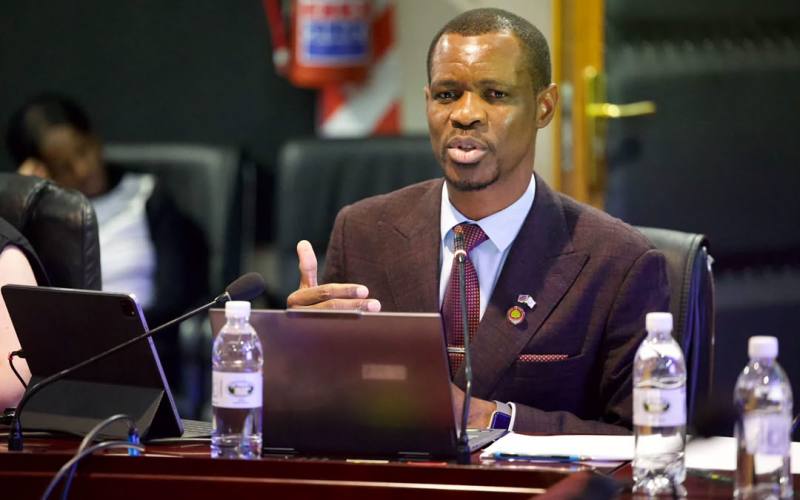
Chief executive officer Moses Matyayi told the parliamentary standing committee on economy and industry, public administration and planning on Tuesday that the municipality had secured a court order to remove people refusing to relocate, as the dispute continues to affect the N$381 million Eneas Peter Nanyemba Road upgrade.
“Unfortunately, we have to resort to the legal matters where we have to go to court to get a court order in order to be able to compel these individuals to then move,” Matyayi said.
He further confirmed that the order had been obtained, adding: “We have gotten the court order, and we will be able to move those that continue to refuse in a manner that will allow us to move.”
Matyayi did not specify whether the court order targets traders operating along the road reserve or households occupying the land earmarked for the new market.
He, however, said the market was initially designed to accommodate 88 traders, but the number requiring space had grown to about 350.
“We are currently standing at around 350 traders that need to now be accommodated in a market that was only meant for 88 traders,” he said.
The road upgrade requires the road reserve to be cleared.
The municipality has identified alternative trading areas in Havana Extensions 8 and 10, but Matyayi said some traders had accepted relocation while others refused to leave their trading areas.
Independent Patriots for Change (IPC) MP Abed Hishoono urged the municipality not to rush into court action, saying traders had reasons for resisting the proposed relocation site.
Hishoono said the area was too far from their current trading location and lacked basic services, including proper roads, water, electricity, a police station and a clinic.
He urged Matyayi to visit the area and speak directly to the affected people rather than to rely on group meetings or legal pressure.
“Start your car, go there, speak to those people,” Hishoono said.
He argued for the municipality to give the community time to explain its concerns and work towards a solution that considers the livelihoods of traders.
Affirmative Repositioning ( AR) leader and MP Job Amupanda also called for court action to be treated as a last resort, citing the economic pressures facing the people affected.
“I’m sure that the court order to evict those people is the only last resort that is available to the leadership of the city,” Amupanda said.
Amupanda urged the municipality to involve elected political representatives in finding a workable solution.
He also questioned spending money on legal proceedings when the funds could instead support development, arguing that direct engagement could help avoid unnecessary costs.
SWAPO MP Hilma Iita advised the municipality to change its negotiation strategy, recommending that officials meet traders individually rather than address them as a group.
“Whenever you are negotiating with vendors, don’t negotiate in a group, speak to them individually and you will succeed,” Iita said.
MP and the committee’s chairperson Iipumbu Shiimi also raised the broader challenge of informal settlements and housing.
Referring to the 29 000 people who had received certificates of occupation, Shiimi said the municipality should continue expanding the number.
“We want to see that number swelling up, that number increasing,” he said, noting that the number of people living in informal settlements remained much higher.
Shiimi’s comments placed the Havana dispute within the wider pressure on Windhoek to provide housing and services as its population grows.
Matyayi told the committee that the city’s population was about 540 000, with around 12 000 new residents arriving each year, adding to the challenge of planning and providing services.
He maintained that the municipality had a legal responsibility to regulate informal trading and ensure vendors operated in designated areas.
“We would not want to do anything outside what the law actually would require us to do,” he said.
The N$381 million road project is intended to upgrade Eneas Peter Nanyemba Road from a single carriageway to a dual carriageway.
The unresolved relocation dispute has held up the Havana Four-Way section, while the financial implications of the delays have not been publicly disclosed by the municipality or project developer Ongos Valley Development.