As the ruling party heads towards another decisive elective congress in 2027, the question is no longer simply who will occupy the top four positions.
It is whether SWAPO can finally make the difficult transition from a liberation movement built around historical loyalties to a modern political party capable of defining itself beyond Sam Nujoma.
There is a question that has hovered over SWAPO for years but has become increasingly difficult to avoid: Has SWAPO really become independent of Sam Nujoma?
This is no longer a question of whether the founding president exercises political control. He has passed from the political arena into history. It is a deeper institutional and psychological question.
Has the Swapo Party developed a sufficiently independent political identity, organisational culture and leadership philosophy to exist comfortably beyond the historical authority of its founder?
The answer may determine the character of the party’s 2027 elective congress.
SWAPO remains Namibia’s governing party. It retained a parliamentary majority in the 2024 elections, winning 51 of the 96 directly elected seats. Netumbo Nandi-Ndaitwah won the presidency with 58.1% of the vote, becoming Namibia’s first female president.
But the trajectory is impossible to ignore.
SWAPO’s parliamentary support was approximately 80% in 2014. It fell dramatically in 2019, when the party lost its two-thirds majority, and fell further in 2024 to just over 53% of the directly elected seats.
The party still won. But winning is not necessarily the same as being politically secure.
The decline suggests that the electorate is becoming less deferential to SWAPO’s historical credentials and more demanding of performance, policy and leadership.
This is the environment in which the next elective congress will take place. And it raises a fundamental question: Will the next SWAPO emerge as a post-Nujoma party, or will it remain essentially Nujoma’s SWAPO with successive generations occupying the same political architecture?
Nujoma’s SWAPO

To understand the difficulty, one must first understand what made Nujoma’s SWAPO so powerful.
SWAPO was not originally conceived as an ordinary political party competing periodically for government. It was a liberation movement.
Its legitimacy was derived from a historical mission: ending colonial rule and securing independence for Namibia. Sam Nujoma was therefore not simply a party president. He was the embodiment of the liberation struggle.
For much of the country’s history, criticism of SWAPO could consequently become entangled with questions of patriotism, liberation credentials and national identity.
That political capital cannot simply be transferred from one generation to another. It must be earned anew.
Nujoma’s greatest political achievement may therefore have been the construction of a movement capable of winning independence.
But his most complicated legacy may be the political culture that developed around that achievement.
It was a culture in which unity was regarded as essential, internal discipline was highly valued and leadership succession was often managed rather than openly contested. This made historical sense during the liberation struggle.
It is more complicated in a constitutional democracy approaching its fourth decade of independence.
Pohamba: the first test beyond Nujoma

Hifikepunye Pohamba provided the first major test of whether SWAPO could survive its founder.
In 2007, Nujoma relinquished the SWAPO presidency after almost five decades at the helm, and Pohamba became the party’s second president.
The transition was peaceful and demonstrated that the organisation was capable of changing leadership without breaking apart. Pohamba was deliberately different from Nujoma.
Where Nujoma was charismatic, combative and deeply associated with the liberation struggle, Pohamba was generally perceived as quieter, more restrained and institutionally conservative. He did not attempt to become another Nujoma. That was important.
Pohamba demonstrated that SWAPO could have a leader who was not its founder and still retain its political identity. But the deeper institutional transition was never fully completed.
Nujoma remained the moral and historical reference point. SWAPO had changed its president. It had not necessarily changed its political DNA.
Geingob and the promise of modernisation

Hage Geingob represented another phase. His political history was more complicated than that of either Nujoma or Pohamba.
His relationship with Nujoma deteriorated badly, but he eventually returned to the political mainstream and rose to the presidency.
Geingob brought with him a different political vocabulary: institutional reform, economic transformation, private-sector development, modernisation and the language of a more contemporary developmental state.
His 2014 electoral victory appeared to confirm the strength of SWAPO.
The party won roughly 80% of the parliamentary vote, while Geingob secured an extraordinary presidential majority. But five years later, the political landscape changed.
SWAPO’s support collapsed significantly in 2019, while Geingob’s presidential vote fell to approximately 56%. The party lost its two-thirds parliamentary majority.
In 2024, it fell further, securing 51 seats. The significance of this decline extends beyond statistics.
The Namibian voter is changing
The post-independence generation is now a major political constituency. Many voters have no personal memory of apartheid or the liberation war.
They know SWAPO primarily as the party of government. That changes the basis on which the party must seek legitimacy.
A young Namibian does not necessarily ask: What did SWAPO do during the liberation struggle?Increasingly, the question is: What can SWAPO do for my future?
Nandi-Ndaitwah and the continuity dilemma
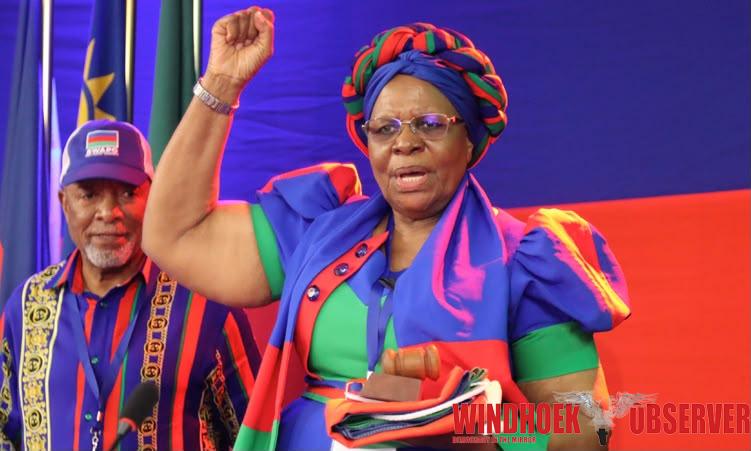
Netumbo Nandi-Ndaitwah therefore occupies a particularly interesting historical position. She represents continuity more strongly than any previous post-Nujoma president.
Her political credentials are rooted deeply in SWAPO and the liberation struggle. Yet she is also a historic figure in her own right.
She became Namibia’s first female president in 2025, following her 2024 electoral victory. Her presidency consequently contains a paradox.
She represents the old SWAPO in terms of political pedigree. But her elevation also represents a significant break with the past.
The question is whether she can preside over the transformation of SWAPO from a liberation movement into a genuinely modern governing party without weakening the historical foundations upon which the organisation was built.
Her own recent message to the party suggests that she understands the challenge.
At SWAPO’s 66th anniversary, she acknowledged that times and public expectations have changed, identifying jobs, land, housing, healthcare and education as central priorities.
Former president Pohamba likewise warned the party that it must continue earning public trust through action.
That may be the most important message for the coming congress.
The zebra problem
But SWAPO faces an unusual problem in determining who should lead it. It is the so-called zebra principle.
SWAPO’s 50/50 gender policy requires equal representation of men and women in party leadership structures and parliamentary representation.
The policy was formally adopted in 2002 and implemented through constitutional changes in 2013.
Academic research describes the reform as the culmination of a prolonged internal struggle, with Nujoma among the senior figures who strongly supported gender parity.
This is an important point.
It would be historically inaccurate to portray gender balance as an ideological burden imposed upon SWAPO from outside.
Nujoma himself was a major proponent of women’s political representation. The policy also produced tangible results.
Following the 2014 election, the proportion of women in the National Assembly increased substantially, with SWAPO’s 50/50 policy playing a major role in that change.
There is therefore a powerful argument for retaining the principle.
Namibia’s political history, like much of Africa’s, has been shaped by male-dominated political structures. Women participated in the liberation struggle and in the building of the post-independence state.
There is a legitimate argument that political institutions should reflect that contribution. But there is another side to the debate.
When gender balance becomes a rigid mathematical formula applied to every leadership contest, critics argue that the party can find itself choosing not simply between the strongest candidates, but between candidates who fit a predetermined gender configuration.
That distinction matters.
The question is not whether women are capable of leading. They clearly are.
The question is whether the best candidate should sometimes be allowed to win regardless of gender, while the party simultaneously develops mechanisms to guarantee meaningful female representation throughout its structures.
This tension became particularly visible during the 2022 congress, when Evelyn !Nawases-Taeyele was eliminated from the deputy secretary-general contest despite finishing ahead of another candidate in the first round, because of the interpretation of the party’s gender-balancing provisions.
The episode illustrated the danger of turning a principle designed to broaden participation into a mechanism that can constrain democratic choice.
SWAPO’s rules require that two of the four top positions be held by women.
The intention is understandable. The practical consequences are more complicated.
The party must therefore confront a difficult question: Does affirmative representation enhance leadership legitimacy when it determines the outcome of a contest, or does it sometimes undermine the perception that the strongest candidates have been allowed to compete on equal terms?
There is no easy answer. Gender is not the only balance. The same debate applies to regional, ethnic and generational considerations. Namibia is a diverse country.
SWAPO itself emerged from a political history in which ethnicity and regional identity could be politically explosive.
Nujoma understood this.
His leadership often sought to construct a broad coalition in which different ethnic, regional and historical constituencies could see themselves reflected in the movement.
That was not simply political window dressing. It was part of nation-building.
A party governing a country as historically divided as Namibia cannot pretend that identity does not matter. Yet there is also a danger in going too far.
If every leadership contest becomes a complicated calculation of gender, tribe, region, generation, liberation credentials and factional allegiance, then the actual question of competence can become secondary.
The result can be a leadership structure that is representative without necessarily being optimally equipped to govern.
That is the dilemma SWAPO must confront. Representation is necessary.
But representation and competence should not be treated as opposing values. The objective should be to produce leadership that is simultaneously representative and capable.
The Helmut Amendments and the closing of the political gate
If the zebra principle creates one constraint, the so-called Helmut Amendments create another.
These amendments, adopted at SWAPO’s 2018 extraordinary congress after proposals associated with veteran Helmut Angula, tightened eligibility requirements for the party’s top leadership.
Among other requirements, aspiring presidents were required to have been party members for 20 uninterrupted years and to have served on the Central Committee for 10 years. The logic was understandable.
SWAPO wanted to protect itself against opportunists and political newcomers joining the organisation merely to capture leadership positions.
Angula argued that leaders should demonstrate commitment and experience rather than arrive at the top of the organisation without having contributed to its development. There is a legitimate institutional argument here.
A political party should not make itself vulnerable to political entrepreneurs who have little ideological or organisational commitment.
But the cure can become worse than the disease.
The amendments have been criticised for creating a gatekeeping mechanism that excludes capable people who may possess the experience necessary to lead Namibia but who do not possess the required SWAPO organisational history.
In 2022, a SWAPO think tank warned that the rules could exclude younger leaders and make the leadership contest procedurally vulnerable.
This is where the contradiction becomes striking. SWAPO says it wants renewal. But renewal requires new people.
New people need opportunities. Opportunities require open competition.
And open competition becomes difficult when eligibility is determined by decades of internal service.
The amendments may therefore protect SWAPO from infiltration while simultaneously protecting the existing establishment from competition. That is a dangerous distinction. The cost of closing the conversation There is another, perhaps more profound, consequence.
When party rules become too restrictive, they do not merely determine who can stand. They influence who feels entitled to speak. This matters enormously for SWAPO.
A healthy political organisation should be able to tolerate internal disagreement. Members should be able to challenge policy, question leaders and argue for alternative approaches without being treated as disloyal.
Yet liberation movements often carry an institutional memory in which dissent is associated with division and division with weakness.
The result can be political conformity.
The irony is that a party that suppresses internal disagreement may eventually find that the disagreement simply moves underground.
The Helmut Amendments therefore raise a philosophical question for SWAPO: Does loyalty mean agreeing with the party’s leadership, or does loyalty mean caring enough about the organisation to challenge it when necessary?
The second interpretation is healthier for a modern political party.
SWAPO should not fear internal competition.
It should fear a situation in which talented members stop competing because they believe the outcome has already been determined by rules, factions or informal succession arrangements.
The 2027 congress
This is why the next congress is potentially more important than the personalities currently being discussed.
The contest for president, vice president, secretary general and deputy secretary general will certainly generate factional manoeuvring. But the deeper contest is between two visions of SWAPO.
One vision sees the party principally as a liberation movement whose unity, history, seniority and internal discipline must be protected.
The other sees SWAPO as a modern political party whose continued legitimacy must be renewed through open competition, policy innovation, generational renewal and demonstrable performance.
Neither vision should be dismissed.
Namibia’s history makes the first necessary.
Namibia’s future makes the second unavoidable. The challenge is to reconcile them. SWAPO does not need to abandon Nujoma.
It needs to graduate from him.
It needs to preserve the values that made the movement successful while discarding those organisational habits that may have outlived their usefulness.
That means retaining gender representation without turning gender into a substitute for merit.
It means recognising Namibia’s ethnic and regional diversity without allowing tribal arithmetic to become the principal determinant of leadership.
It means respecting veterans without making seniority an automatic qualification for power.
It means protecting the party against opportunists without closing the door on talented younger Namibians.
And it means allowing members to disagree without being regarded as enemies. The party has a choice
The most dangerous assumption SWAPO could make is that electoral decline is simply a temporary phenomenon. It is not.
The 2014, 2019 and 2024 elections tell a story. The story is not that SWAPO has become irrelevant. It has not.
The story is that the electorate is becoming less willing to give SWAPO unconditional political loyalty.
That should be understood as a warning, but also as an opportunity.
The party still possesses enormous organisational depth, historical legitimacy and national reach.
It also possesses something many political organisations would envy: the ability to reinvent itself without starting from zero.
The 2027 congress can therefore become a succession contest. Or it can become a renewal congress.
The difference will determine whether the organisation remains trapped in the political shadow of its founder.
Sam Nujoma’s SWAPO had a clear plan for Namibia
Its objective was independence, sovereignty and the creation of a new nation. Pohamba showed that SWAPO could survive its founder. Geingob demonstrated that it could attempt to modernise its political language. Nandi-Ndaitwah now has the opportunity to demonstrate something even more profound: that SWAPO can modernise its political identity.
That will require courage.
It may require changing rules that were once created for legitimate reasons. It may require allowing a stronger field of candidates.
It may require accepting that sometimes the best candidate will not fit neatly into a predetermined gender or regional equation.
And it may require acknowledging that internal democracy is not a threat to unity. It is the foundation of durable unity.
SWAPO now faces a difficult choice.
It can remain, fundamentally, Nujoma’s SWAPO, a party whose authority continues to derive principally from its liberation history and whose internal architecture remains heavily shaped by the political logic of that era.
Or it can enter a new phase: SWAPO as an institution in its own right, a party that respects Nujoma’s legacy but is no longer dependent upon it; a party that can compete internally without fracturing; a party that can embrace women without reducing leadership to gender arithmetic; a party that can recognise Namibia’s diversity without allowing identity politics to overwhelm competence; and a party that can make room for a younger generation without treating experience as disposable.
That is the real battle facing SWAPO. Not simply who becomes president. Not simply who becomes vice president. Not simply who becomes secretary general or deputy secretary general. The real battle is over what SWAPO itself becomes.
Will it remain Nujoma’s party, or will it finally become its own party?
And ultimately, like Sam Nujoma’s SWAPO, the current SWAPO must have a plan for Namibia.
But this time, it must be a plan not merely for preserving the past, but for convincing a new generation that SWAPO still has a credible future.