Patience Makwele
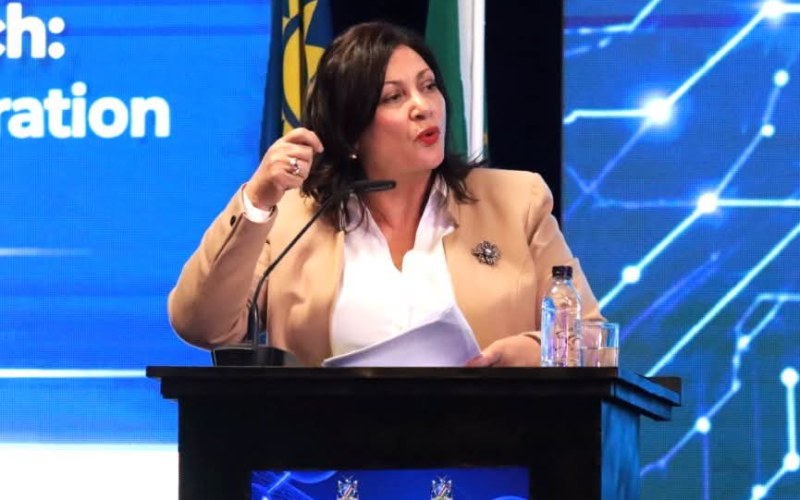
Education minister Sanet Steenkamp has called for closer cooperation between universities and industry to help turn student research into businesses, practical solutions and employment opportunities.
Speaking at the 2026 National Student Research Symposium in Windhoek on Wednesday, Steenkamp said Namibia needed graduates who could create jobs, rather than depend solely on existing employment opportunities.
“Our institutions of higher learning must continue to produce graduates who are equipped for employment, but also capable of creating employment,” she said.
The symposium, held under the theme “Harnessing AI to Catalyze Transformative Research: Empowering the Next Generation of Innovators”, brought together students, academics, government officials and industry representatives to discuss the role of research and technology in Namibia’s development.
Steenkamp said research should address problems facing the country, including food production, water shortages, healthcare and energy, rather than remain confined to academic reports.
“Research must not end with the production of a report. It must contribute to the production of knowledge, the development of solutions and, wherever possible, the creation of economic and social value,” she said.
She said Namibia’s natural resources alone would not guarantee prosperity, arguing that the country also needed the skills and technology to process resources locally and build industries that could sustain employment.
“Our future prosperity will depend not only on what Namibia possesses, but also on what Namibians know, what we can create, and what we can produce,” Steenkamp said.
The minister said universities, government and businesses needed to work more closely to give promising research a chance to be developed and applied beyond the classroom.
She said businesses could help researchers identify practical problems, while universities provided the expertise needed to investigate them.
The government, meanwhile, had a role in supporting collaboration and creating conditions in which new ideas could be tested.
Steenkamp said a student project could eventually become a product, service or business if researchers received the necessary guidance and opportunities to develop their work.
Not every research project would become a commercial venture, she cautioned.
Research could also improve public services, inform government decisions and strengthen professional practice.
She said Namibia needed research that could support local manufacturing, improve food security and contribute to emerging industries, while also addressing challenges experienced by communities.
Steenkamp said artificial intelligence could help researchers analyse information, identify patterns and develop new products and services.
However, she warned against relying on technologies developed elsewhere without building local expertise.
“Namibia must aspire to become more than a consumer of digital solutions,” she said.
She called for investment in research facilities, digital connectivity and the skills needed to develop technology suited to Namibia’s needs.
The minister also warned students that AI tools could produce inaccurate or biased information and that their use raised questions about privacy, intellectual property and academic integrity.
“AI can assist a researcher, but it cannot relieve that researcher of the responsibility to think critically, verify evidence and defend conclusions,” she said.
Lisho Mundia, deputy executive director for higher education, training, research and innovation, said the symposium was intended to help students develop their research skills and connect with people and institutions that could support their work.
Speaking on behalf of executive director Erastus Mbumba Haitengela, Mundia said the programme included sessions on research proposals, intellectual property, funding, postgraduate studies and career opportunities.
He said research, science, technology and innovation were recognised as important drivers of national development under the Sixth National Development Plan.
Steenkamp urged students to use the symposium to engage with mentors, exchange ideas and establish relationships with potential collaborators and industry partners.
She said Namibia needed to create opportunities for young people to develop their ideas and contribute to the country’s future.