Patience Makwele
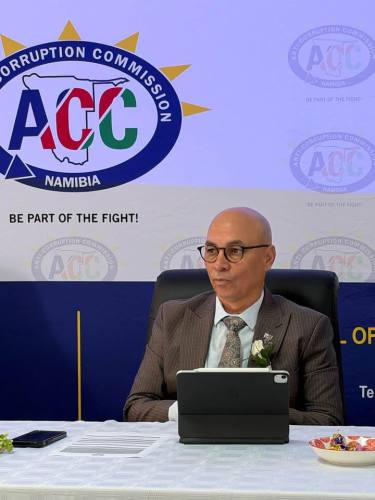
The Anti-Corruption Commission (ACC) has been urged to intensify its efforts to prevent and combat corruption in Erongo, where bribery was pointed out as the most commonly reported offence as dozens of cases remain unresolved.
ACC director-general Bryan Eiseb warned that corruption could undermine Namibia’s hopes of benefiting from its emerging oil and gas sector, saying public resources meant to improve people’s lives must not be diverted for personal gain.
“We all speak about oil and gas. We all speak about the potential of what it holds for us as a developing country. But I believe that corruption may as well derail those hopes,” Eiseb said at a media briefing at Mile 4 Caravan Park in Swakopmund on Tuesday.
He stressed that corruption could divert resources from essential public services, infrastructure and education, while deepening poverty and inequality.
Eiseb said the ACC had an accumulated caseload of 94 cases in Erongo, including matters carried over from previous years.
He clarified that only 20 cases had been reported during the 2024/25 and 2025/26 financial years under review.
“So it’s an accumulation of cases in the Erongo region, but for the particular period under review, only 20 cases, rather, were reported,” he said.
He said 55 cases were under investigation, while 21 were before the courts.
Five had been closed due to insufficient evidence to support the allegations, four had been referred back by prosecutors for further investigation, and seven were awaiting decisions by the Prosecutor-General.
“Only one case has resulted in a conviction, not that false convictions are the ultimate solution to corruption, but the law has the following scores,” Eiseb said.
The case-status figures presented at the briefing do not account for all 94 cases, and the ACC’s breakdown requires clarification.
Eiseb said the cases reported in Erongo predominantly involved bribery, misuse of power and theft of state money.
“Colleagues, the most important reported cases in Erongo relates to bribery. In some cases, they were attempts to bribe a NamRA official, officials from our vehicle registration office called NaTIS, and some customs officials,” he said.
He said the reports pointed to corruption concerns within the public sector and public enterprises.
The allegations involving officials do not, in themselves, establish that those individuals committed wrongdoing.
Eiseb warned that corruption was not simply a matter of individual misconduct, but could undermine public institutions and prevent government programmes from reaching the people they were intended to serve.
“The citizens of most developing countries, of which Namibia is not immune, have continued to wallow in poverty, not because there are no deliberate government programmes to improve their standards of living, but because the sheer greediness and selfishness by individuals and public officials entrusted with resources, public resources, tries to accumulate that for their personal gain, and that must stop,” he said.
He said the commission intended to strengthen cooperation with the Namibian Police (NAMPOL), Financial Intelligence Centre (FIC), Office of the Prosecutor-General and civil society to better understand corruption trends and coordinate responses.
The briefing also highlighted difficulties facing the ACC’s corruption-prevention work in the region.
The commission reported reaching more than 1 400 public- and private-sector officials through seminars and workshops during the two financial years.
It also conducted corruption risk assessments and trained life-skills teachers to use its anti-corruption education manual.
However, ACC officials identified limited funding and resistance from some institutions to staff training as obstacles to the commission’s work.
Fillemon Enkali, a senior public education and corruption prevention officer at the ACC’s Swakopmund office, said some institutions made excuses when approached to allow the commission to address or train their employees.
“We always hear excuses here and there, and that is actually affecting the work of the ACC very much,” he said.
The commission called on senior officials to intervene and urged institutions to budget for implementing the national anti-corruption strategy.
Eiseb said Cabinet had recently approved a new National Anti-Corruption Strategy and Action Plan to replace the previous plan, which ended in 2025.
In his call for greater public scrutiny, Eiseb pledged more frequent engagement with journalists, saying the commission would provide information on its activities and investigations while balancing the public’s right to know with the presumption of innocence.
“The days of a silent institutional approach are long gone,” he said.
His comments followed a question about allegations concerning a double-plot allocation, governance failures and accommodation arrangements involving the Swakopmund Municipality’s chief executive officer.
Eiseb said he had been in office for about eight days and had not yet reviewed the specific matter. He therefore could not confirm whether the commission had opened an investigation into it.
He however said more than 700 matters had been registered nationally with the ACC, but stressed that registration did not automatically mean an investigation had been opened or that wrongdoing had been established.
Matters first undergo an initial assessment to determine whether grounds for investigation exist.
Erongo governor Nathalia /Goagoses welcomed the engagement and said the regional leadership would cooperate with the commission in implementing anti-corruption measures.
Eiseb said tackling corruption required the involvement of public servants, the media and the wider public.
“We will rely on the media, we will rely on each and every public servant, to root out corruption where it rears its ugly head,” he said.