CHAMWE KAIRA
The country recorded strong growth in livestock auctions and horticultural exports during the first quarter of 2026, while cereal grain imports and horticultural imports declined, according to the Namibia Statistics Agency’s (NSA) Agriculture and Fishing Indicator Statistical Bulletin for the first quarter of 2026.
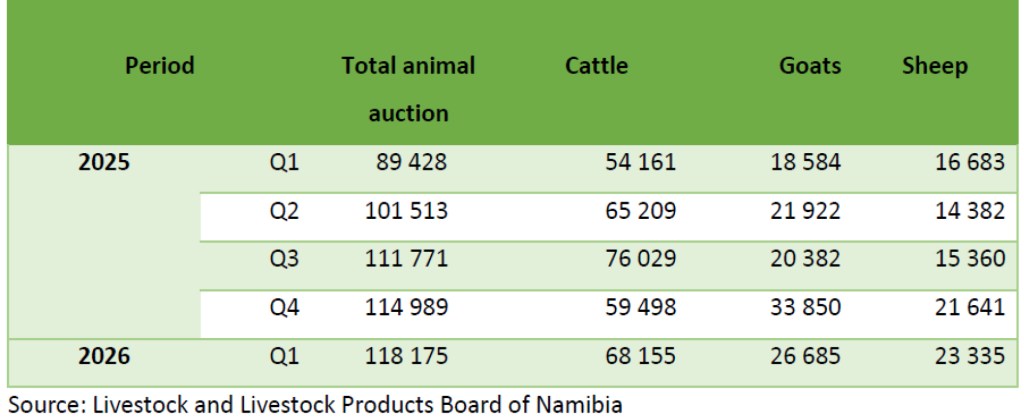
The bulletin shows that the total number of animals auctioned increased by 32.1% to 118 175 during the first quarter of 2026, compared to 89 428 in the corresponding quarter of 2025.
Cattle accounted for the largest share of livestock sold at auction, with 68 155 head, followed by 26 685 goats and 23 335 sheep.
Livestock prices were mixed during the period. Goat prices recorded the highest average weighted price at N$36.99 per kilogram, representing a 2.1% increase from a year earlier.
Cattle prices rose by 1.7% to N$35.03 per kilogram, while sheep prices declined by 12.5% to N$28.63 per kilogram.
In terms of cereal grain imports, Namibia imported cereal grains worth N$467.7 million during the first quarter, down 52.1% from N$976.6 million in the same period of 2025.
Maize remained the country’s largest imported grain, valued at N$320.0 million, followed by wheat at N$140 million.
Imports of oats totalled N$4.3 million, while rice and sorghum imports were valued at N$1.5 million and N$1.2 million, respectively.
South Africa supplied 71.4% of Namibia’s cereal grain imports during the quarter, followed by Lithuania with 20.1% and Poland with 8.2%.
The NSA said maize imports were sourced mainly from South Africa, while wheat imports primarily originated from Lithuania and Poland.
Meanwhile, Namibia’s horticultural exports more than doubled during the quarter. The country exported horticultural products valued at N$668 million, compared to N$262 million in the first quarter of 2025, representing a 155% increase.
Grapes remained Namibia’s leading horticultural export, generating N$561.3 million. Dates followed with exports worth N$101.5 million, while pumpkins, squash and gourds contributed N$2.7 million. Vegetable seeds, excluding beet seeds, accounted for N$2 million.
The Netherlands was the largest destination for Namibian horticultural exports, receiving 39.7% of total exports, followed by the United Kingdom at 26.8% and Germany at 7.6%.
On the import side, Namibia’s horticultural import bill declined by 4.1% to N$331.8 million during the first quarter, compared to N$346.0 million in the same period last year.
Potatoes were the country’s largest horticultural import at N$56.4 million, followed by apples worth N$32 million and onions valued at N$16.2 million.
South Africa remained the dominant supplier of horticultural products, accounting for 96.4% of Namibia’s imports during the quarter.